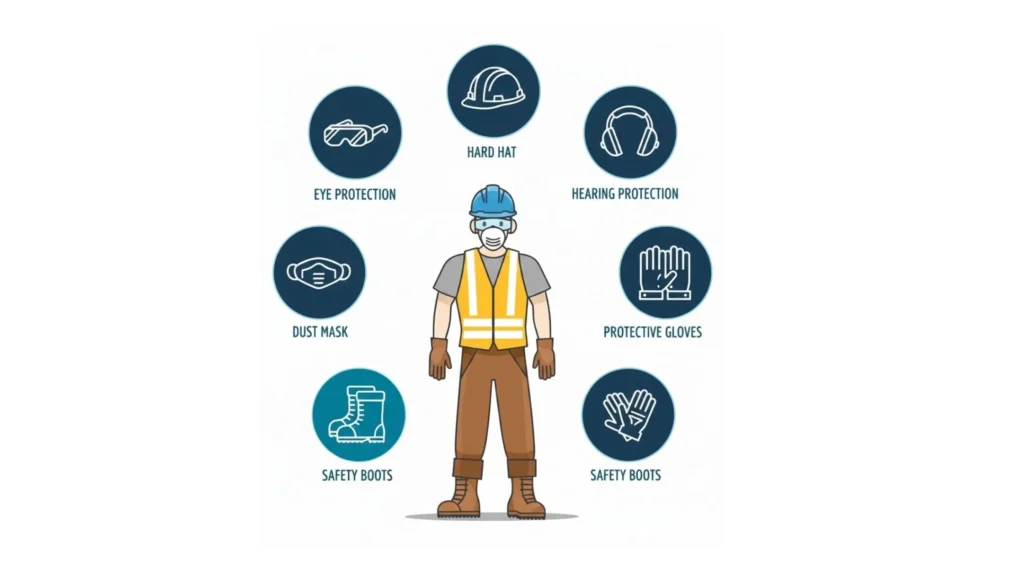
Quick Answer: PPE must be cleaned after every use or shift (daily for high-exposure environments), formally inspected before each use and on a documented schedule (monthly/quarterly), and replaced based on manufacturer lifespan, visible damage, chemical exposure history, or after any impact event — not just on a fixed calendar. Different PPE types have different replacement triggers. This guide covers all of them.
Why PPE Maintenance Is Not Optional
In the UAE, workplace safety is governed by OSHAD (Abu Dhabi) and Dubai Municipality HSE standards, UAE’s HSE Standards for PPE align closely with international frameworks from OSHA, EN, and ISO. Yet across construction sites in Dubai, manufacturing floors in Sharjah, and oil & gas facilities in Abu Dhabi, the same compliance gap appears repeatedly: workers receive certified, high-quality essential safety equipment— and then it is never properly maintained.
The result? A hard hat that has absorbed a hidden impact still looks fine. A safety harness stored in UV-exposed conditions looks intact but its webbing has lost 40% of its load capacity. Gloves contaminated with chemical residue are reused on the next shift. PPE is not maintained — it is worn until it visibly falls apart.
That is not safety. That is the illusion of safety.
This guide breaks down exactly how to clean, inspect, and replace every major category of PPE — not as a bureaucratic checklist, but as an operational system that EHS managers can implement and workers can follow without confusion.
PPE Cleaning — The Right Way for Every Equipment Type
Cleaning is the first line of defence for PPE longevity and effectiveness. The biggest mistake most workplaces make is treating cleaning as cosmetic — removing visible dirt — rather than functional: removing chemical contamination, biological hazards, and substances that degrade protective materials.
General Principles of PPE Cleaning
- Always consult the manufacturer’s care label or technical data sheet before cleaning any PPE item.
- Use only cleaning agents compatible with the PPE material — many solvents that clean effectively also destroy protective coatings or weaken fibres.
- Never mix cleaning agents. Bleach + ammonia-based cleaners produce toxic chloramine gas — a particular hazard when cleaning chemical-contaminated PPE.
- Rinse thoroughly after cleaning. Detergent residue on respiratory masks, gloves, or skin-contact garments can cause dermatitis or interfere with protective coatings.
- Dry completely before storage. Damp PPE promotes microbial growth, weakens adhesives, and accelerates corrosion of metal components.
1. Hard Hats & Safety Helmets
Hard hats used daily in construction, oil & gas, and manufacturing environments accumulate not just surface dirt but UV-degraded plastic, solvent residue, and sweat-based biological contamination on the suspension system.
- Use warm water (max 40°C) and mild detergent — dish soap is acceptable.
- Remove the suspension harness and headband and clean them separately, as sweat salt accumulates at contact points and degrades foam padding faster than the shell.
- Wipe the shell exterior with a soft cloth — never use abrasive scrubbers, which create micro-scratches that weaken the polycarbonate or ABS structure.
- Never use solvents (acetone, thinners, petrol) to clean hard hats. These chemicals — even brief contact — cause stress cracking in the plastic that is invisible externally but catastrophically reduces impact resistance.
- Do not paint, apply stickers, or use adhesives on hard hat shells unless the manufacturer explicitly approves.
- Cleaning frequency: After every shift in high-contamination environments (chemical plants, dusty sites); weekly in lower-exposure environments.
2. Safety Gloves
Safety Gloves are the most frequently contaminated PPE item and the most under-cleaned. EN 388-rated cut-resistant gloves, chemical-resistant gloves, and general-purpose work gloves each require different cleaning approaches.
- Cut-resistant gloves (HPPE, Kevlar, stainless steel mesh): Hand-wash in warm water with mild detergent. Rinse thoroughly. Air-dry flat — do not wring or machine-dry, as this distorts the fibre alignment and reduces cut resistance.
- Chemical-resistant gloves (nitrile, neoprene, PVC, butyl rubber): After each use, rinse the exterior thoroughly with clean water before removing. Then clean with appropriate solvent or water-based cleaner depending on the chemical contacted. Check the glove’s chemical resistance chart — many chemicals require specific neutralisation before washing.
- Leather work gloves: Clean with a damp cloth and leather-specific conditioner. Do not machine wash — water saturation stiffens and shrinks leather, reducing dexterity.
- Disposable gloves: Never reuse. Dispose after each task.
Important note for UAE conditions: The extreme heat in UAE summers (June–September) causes sweating inside gloves that accelerates the breakdown of synthetic liners and promotes bacterial growth. Increase cleaning frequency during summer months.
3. Safety Footwear
Safety shoes — particularly those meeting EN ISO 20345 standards for steel toe, puncture resistance, and slip resistance — accumulate debris that compromises more than appearance. Packed mud in sole cleats eliminates slip resistance, chemical residue attacks the sole adhesive bond, and salt from perspiration degrades leather uppers.
- After each shift: Knock off loose debris. Brush the sole with a stiff-bristled brush to clear cleats. Wipe the upper with a damp cloth.
- Weekly deep clean: Wash the upper with lukewarm water and mild soap. Remove insoles. Wipe the interior with an antibacterial cloth. Condition leather uppers monthly with appropriate leather conditioner.
- Never machine wash or tumble dry safety shoes. The heat destroys PU midsole foam and the adhesive bonding the sole to the upper.
- If shoes are soaked, stuff with newspaper and dry at room temperature for at least 24 hours. Never use direct heat sources.
Related: How to Make Your Safety Shoes Last Longer
4. High-Visibility Jackets & Safety Garments
Hi-vis garments (EN ISO 20471 / EN 471 certified) rely on two components: fluorescent background fabric and retroreflective tape strips. Both degrade with washing, UV exposure, and contamination. Maintaining them sustains the photometric performance that makes them legally compliant.
- Machine wash at 40°C maximum (check the label — some hi-vis garments allow only 30°C).
- Use phosphate-free, optical brightener-free detergents. Optical brighteners in standard laundry detergent reduce retroreflective luminance in vehicle headlight conditions at night.
- Never use bleach on hi-vis garments — it degrades both the fluorescent backing and the retroreflective microsphere layer on the tape.
- Hang-dry or tumble dry on low heat. High heat causes retroreflective tape to delaminate from the backing fabric.
- After washing, check that retroreflective strips still produce a strong reflected beam under overhead light. Reduced reflection = the garment is no longer compliant.
5. Respirators & Respiratory Protective Equipment
Respirators are safety-critical equipment where inadequate cleaning can directly cause harm — contaminated face seals allow toxic gas or particulate ingress, and degraded filter media allows pass-through of the contaminant the respirator is designed to block.
- Half-face and full-face reusable respirators (e.g., Sundstrom SR200/SR500 series): After each use, remove and safely dispose of filters. Clean the facepiece, valves, and head harness with warm water and approved respirator cleaning solution or unscented soap. Rinse thoroughly. Air-dry completely before storage or filter replacement.
- Valves (inhalation and exhalation) are the most critical components — inspect for cracks, distortion, or debris before each use. Blocked or damaged valves are a leading cause of respirator failure.
- Filters are NOT cleanable. Never attempt to wash, blow out, or dry filters and reuse them. A washed filter appears intact but its media is structurally compromised. Replace per manufacturer guidance.
- Store cleaned respirators in sealed bags away from ozone sources (electrical motors, UV lights) as ozone degrades silicone and rubber seals rapidly.
6. Hearing Protection
- Earmuffs: Wipe cushions and ear cups with an alcohol-based disinfectant wipe weekly. Check that foam cushions still conform firmly to the face — compressed or hardened cushions significantly reduce the Noise Reduction Rating (NRR). Replace cushions every 6–12 months or when deformation is visible.
- Reusable earplugs: Clean with mild soap and water after each use. Inspect for tears, hardening, or loss of elasticity. A deformed or hardened earplug does not seal the ear canal.
- Disposable foam earplugs: One-use only. Discard after each shift. Reusing disposable plugs is the single most common hearing protection compliance failure in industrial environments.
7. Protective Eyewear & Face Shields
- Clean lenses with an approved microfibre cloth or anti-fog lens cleaning solution. Never wipe dry lenses with rough cloth — micro-scratches reduce optical clarity and increase glare. Scratched lenses must be replaced.
- Face shields: Clean the visor with a damp cloth and mild soap. Inspect for crazing (fine surface cracking) or yellowing — both indicate UV degradation and reduced impact resistance.
- Never use ammonia-based cleaners on anti-fog-coated lenses — the coating is destroyed.
8. Fall Protection — Harnesses, Lanyards & Anchor Systems
Fall protection equipment is life-safety equipment. A harness or lanyard that looks fine externally may have internal fibre degradation or chemical contamination that reduces its load capacity below the legally required minimum — with no visible sign.
- After each use: Remove any dirt or debris. Check for chemical contamination — many industrial chemicals attack polyester and nylon webbing. If chemical contact has occurred, document it and have the harness assessed before next use.
- Formal cleaning: Use warm water and mild soap. Hand-wash webbing gently. Rinse thoroughly. Hang to dry in a cool, shaded, well-ventilated area. Never machine wash harnesses.
- Never use bleach, solvents, or high-pressure washers on harnesses.
- Store in a dry, UV-protected bag or locker. UV is the primary cause of webbing degradation in UAE outdoor conditions — intense sunlight and heat at outdoor sites can degrade a harness significantly within a single season if left in direct sunlight.
PPE Inspection — What to Check and When
Inspection is where most workplaces take shortcuts. A pre-use visual check is not the same as a formal inspection. Both are required — and they serve different purposes.
The Three Tiers of PPE Inspection
| Inspection Tier | Who | Frequency | Purpose |
|---|---|---|---|
| Pre-use check | Worker | Every use | Identify obvious damage, contamination, or missing components before putting the PPE on |
| Periodic formal inspection | Competent person (EHS officer, supervisor) | Monthly / Quarterly (PPE-type dependent) | Systematic documented review of structural integrity, compliance markings, expiry, and function |
| Thorough examination | Specialist (manufacturer, certified inspector) | Annually or after any incident | In-depth assessment required for fall protection, respiratory equipment, and life-safety systems |
Pre-Use Inspection: Hard Hats
- Squeeze the shell gently — it should spring back. Any cracks, deep scratches, holes, dents, or chalky surface indicates UV degradation or impact damage.
- Inspect all suspension straps, rivets, and the headband for tears, fraying, missing rivets, or broken ratchet mechanisms.
- Check the date stamp on the interior: both shell manufacture date and suspension manufacture date have independent lifespans.
- Remove from service immediately if: the shell shows any crack, any suspension component is broken, the shell has been painted with solvent-based paint, or the helmet has sustained any significant impact.
Pre-Use Inspection: Safety Harnesses & Lanyards
- Webbing: Run the webbing slowly through your hands, feeling for cuts, abrasions, burn marks, chemical stiffening, or discolouration. Hold to the light and check for edge fraying.
- Hardware: All buckles, D-rings, snap hooks, and carabiners — gates must open, close freely, and lock positively. Deformed, corroded, or bent hardware = immediate retirement.
- Stitching: Examine all load-bearing stitching at D-rings, buckles, and connection points. Any cut, frayed, or missing stitching is a critical failure point.
- Shock absorbers: If the deployment indicator is visible (the orange/yellow tear strip is exposed), the lanyard has been deployed in a fall arrest event and must be retired immediately.
Pre-Use Inspection: Safety Gloves
- Inflate test for chemical-resistant gloves: Roll the cuff to trap air, then squeeze. Any air escaping indicates a puncture or crack — the glove is unfit for chemical handling.
- Check seams, fingertips, and palm areas for abrasion, thin spots, or breakthrough contamination (discolouration from chemical contact inside the glove).
- For cut-resistant gloves: check for cut-through damage to the protective layer — this reduces the overall cut resistance rating.
Pre-Use Inspection: Respirators
- Seal check: After donning the respirator, cover the exhalation valve and exhale gently. The facepiece should balloon slightly and hold pressure. Air escaping around the seal = fit failure.
- Filter check: Verify the filter’s end-of-service life indicator (ESLI) where available. Check that filters are within their unopened shelf-life date.
- Valve check: Inhalation and exhalation valves should open and close cleanly with each breath. Sticky, warped, or debris-fouled valves prevent the respirator from functioning correctly.
Formal Inspection Schedule — All PPE Types
| PPE Type | Formal Inspection Frequency | Key Standard |
|---|---|---|
| Hard hats / Safety helmets | Monthly documented check; annual competent person review | EN 397 / ANSI Z89.1 |
| Safety harnesses & lanyards | Before every use + 6-monthly by competent person + annual by specialist | EN 361 / ANSI Z359.1 |
| Safety gloves | Before every use; weekly formal check for chemical-resistant gloves | EN 388 / EN 374 |
| Safety footwear | Weekly visual; formal quarterly assessment | EN ISO 20345 |
| Hi-vis garments | Before each use; monthly retroreflectivity check | EN ISO 20471 |
| Respirators | Before every use; monthly formal inspection | EN 149 / NIOSH / EN 136 |
| Eye protection | Before every use; monthly lens and frame check | EN 166 / ANSI Z87.1 |
| Hearing protection | Weekly earmuff seal check; monthly earplug condition check | EN 352 |
PPE Replacement Frequency — When PPE Must Be Retired
The most dangerous misconception in PPE management is that equipment should only be replaced when it visibly fails. Many categories of PPE must be retired based on elapsed time, usage cycles, or exposure history — regardless of visual condition.
Hard Hats
- Shell replacement: Every 2–5 years from manufacture date (manufacturer-specific). In outdoor UAE environments, most thermoplastic shells (ABS, HDPE, polycarbonate) must be replaced within 2–3 years due to accelerated UV degradation. Fibreglass shells typically have a 5-year service life.
- Suspension replacement: Every 1–2 years regardless of shell condition, or sooner if any component shows wear.
- Immediate replacement triggers: Any impact (even if the hat looks undamaged — the shell absorbs energy through microcracking invisible externally); any crack, deep scratch, or dent; any paint or solvent contamination; any chalking or brittleness indicating UV degradation.
Safety Harnesses & Lanyards
- Service life: Maximum 10 years from manufacture date (ANSI Z359.1). In UAE conditions — high UV, extreme heat, potential chemical contamination — most harnesses should be retired at 5–7 years from manufacture even with no visible defects.
- Retire immediately after any fall arrest event — no exceptions, regardless of apparent condition.
- Retire if webbing shows any cut, significant abrasion, or load-bearing stitching damage.
- Retire if any hardware is deformed, corroded, cracked, or operates with reduced smoothness.
- Shock-absorbing lanyards: retire immediately after deployment (visual deployment indicator is activated).
Safety Gloves
- Disposable gloves: After every use — no exceptions.
- Chemical-resistant gloves: Replace at the first sign of permeation (breakthrough contamination visible inside the glove), puncture, or cracking. Never store chemically contaminated gloves — contamination migrates through the material over time.
- Cut-resistant gloves: Replace when cut-through damage is visible in the protective layer, when grip coating has worn smooth, or when fibre alignment is visibly distorted.
- General leather/synthetic gloves: Replace when seams split, fingertips wear through, or grip is compromised.
Safety Footwear — Replacement Triggers
| Replacement Trigger | Action |
|---|---|
| Midsole compression (shoe feels flat) | Replace — cushioning and sole protection compromised |
| Sole delamination (sole lifting from upper) | Replace immediately — waterproofing and structural integrity lost |
| Toe cap damage (dent, crack) | Replace immediately — toe cap may no longer meet EN ISO 20345 |
| Upper cracking or perforations | Replace — water and chemical ingress risk |
| Lost slip resistance (smooth sole cleats) | Replace or resole — slip protection compromised |
| Calendar-based (daily industrial use) | 12–24 months; up to 36 months for light-use environments |
Related: How Long Do Safety Shoes Last? A Complete Care Guide
High-Visibility Garments
- Replace after 25–50 wash cycles (check the care label for the manufacturer’s rated wash count).
- Replace immediately if retroreflective tape shows peeling, cracking, or significantly reduced reflectivity when tested with a torch in a darkened area.
- Replace if fluorescent fabric has visibly faded or colour has shifted from the required yellow-green or orange toward a dull khaki or pastel.
- Replace if the garment is contaminated with oil, paint, or adhesive — contamination on retroreflective tape permanently reduces its performance.
Respirators & Filters
- Reusable facepieces: Replace when seals crack, when there is structural damage to the facepiece body, or when the facepiece no longer passes the positive/negative pressure user seal check. Service life is typically 5–10 years depending on storage and frequency of use.
- Particulate filters (P1/P2/P3): Replace when breathing resistance noticeably increases, when contamination is visible, or after the shift in high-contamination environments. Never reuse single-shift particulate filters.
- Gas and vapour cartridges: Replace at the end of each shift, after exposure to detectable vapour concentrations, or according to a documented change schedule per EN 14387.
- Disposable filtering facepieces (FFP2/FFP3): Single-shift use. Dispose at the end of each working day or sooner if breathing resistance increases or the mask becomes wet or contaminated.
Hearing Protection
- Earmuff cushions: Replace every 6–12 months or when visibly compressed, cracked, or when they have lost conformity to the face.
- Earmuff headband: Replace when it no longer holds cups firmly against the head — reduced clamping force means reduced attenuation.
- Reusable earplugs: Replace when they no longer expand fully after rolling, have lost their soft elasticity, or are visibly damaged. Typical lifespan: several weeks to a few months with regular cleaning.
- Disposable earplugs: One shift, one pair. No exceptions.
Protective Eyewear
- Replace when the lens has visible scratches, crazing, pitting, or any deformation — even minor optical distortion compromises safety by impairing vision.
- Replace when the frame is cracked, bent, or when lens retention is loose.
- Replace face shield visors when crazing, yellowing, or deep scratching is present.
- Anti-fog coatings typically last 12–18 months under regular use. Once anti-fog performance is gone, replace before working in fogging environments.
PPE Replacement Quick-Reference Guide
| PPE Item | Typical Service Life | Immediate Replacement Triggers |
|---|---|---|
| Hard hat shell | 2–5 years (manufacture date) | Any impact, crack, paint/solvent contact, chalking |
| Hard hat suspension | 1–2 years | Any broken or frayed component |
| Safety harness | 5–10 years (max) | Any fall arrest event; cut/damaged webbing; hardware failure |
| Shock-absorbing lanyard | 10 years (max) | Any deployment (deployment indicator activated) |
| Chemical-resistant gloves | Condition-based | Perforation, breakthrough contamination, cracking |
| Cut-resistant gloves | Condition-based | Cut-through visible; grip worn smooth |
| Safety shoes | 12–24 months (heavy use) | Toe cap damage, sole delamination, midsole compression |
| Hi-vis jacket | 25–50 wash cycles | Faded fluorescent fabric; reduced retroreflectivity |
| Full-face respirator (facepiece) | 5–10 years | Seal cracking; fail on seal check; structural damage |
| Particulate filters (P2/P3) | 1 shift / as needed | Increased breathing resistance; contamination; wetness |
| Gas/vapour cartridges | Per service life calculation | End of shift; detectable smell; defined exposure limit |
| FFP2/FFP3 disposable masks | 1 shift | Never reuse — single use only |
| Earmuff cushions | 6–12 months | Compression; cracking; loss of seal |
| Safety glasses / goggles | Condition-based | Any lens scratch, crazing, or distortion; frame damage |
Industry-Specific PPE Maintenance in the UAE
| Industry | High-Priority PPE | Key Maintenance Challenge |
|---|---|---|
| Construction | Hard hats, harnesses, safety shoes, gloves, eye protection | UV degradation from outdoor exposure; unreported impact events on helmets |
| Oil & Gas | Respirators, chemical-resistant gloves, FR coveralls, safety shoes | Chemical contamination requiring specialist decontamination; extreme heat accelerating material degradation |
| Manufacturing | Eye protection, hearing protection, gloves, safety shoes | High-frequency use increasing wear rate; earmuff cushion degradation |
| Warehousing | Safety shoes, high-vis jackets, gloves | Hi-vis retroreflectivity loss from frequent washing; sole wear from forklift traffic areas |
| Chemical handling | Chemical-resistant gloves, full-face respirators, coveralls, safety shoes | Permeation breakthrough requiring strict replacement schedules; respirator seal degradation from solvent exposure |
| Healthcare | Gloves, masks, face shields, coveralls | Infection control requiring single-use compliance; decontamination protocols for reusable items |
Frequently Asked Questions on PPE Maintenance
How do you clean personal protective equipment?
Clean PPE using the method appropriate for each equipment type. General principles: use warm water and mild, compatible detergents; never use harsh solvents unless specifically recommended for chemical decontamination; rinse all cleaning agents thoroughly; and always allow PPE to air-dry completely before use or storage. Specific cleaning methods differ significantly by PPE type — refer to the equipment-specific sections above and always consult the manufacturer’s instructions.
How often should PPE be inspected?
PPE inspection operates on three levels: a pre-use check before every single use (performed by the worker); a formal periodic inspection (monthly or quarterly, depending on PPE type) conducted by a competent person; and a thorough examination (typically annual) for life-safety equipment like fall protection and respiratory systems. For high-risk environments, all inspection frequencies should be increased.
When should PPE be replaced?
PPE should be replaced when it shows visible damage, when it has reached its manufacturer-stated service life, or when it has experienced a qualifying event — such as a fall arrest for harnesses, or impact for hard hats. Many types of PPE must be replaced on schedule even with no visible defects. UV-degraded hard hat shells and chemically saturated gloves are common examples of PPE that appears fine but is no longer protective.
Can PPE be sanitized and reused?
Reusable PPE — such as full-face respirators, safety harnesses, hard hats, and multi-use gloves — can be cleaned and reused according to manufacturer guidelines. Disposable PPE (FFP2/FFP3 masks, disposable gloves, single-use earplugs) must never be reused. Sanitization is appropriate for shared PPE items when multiple workers use the same equipment — but sanitization does not extend the structural lifespan of the PPE.
How do you maintain a safety harness?
After each use: remove contamination and debris, and inspect all webbing, hardware, and stitching. Clean with warm water and mild soap — never machine-wash, dry-clean, or use bleach. Store in a dry, UV-protected bag or compartment, away from heat sources and chemicals. Have the harness formally inspected every 6 months by a competent person. Retire it immediately after any fall arrest event or if any component fails inspection, regardless of overall appearance.
How to extend the lifespan of personal protective equipment?
The four practices that most extend PPE lifespan: regular cleaning immediately after use (before contamination sets into materials); correct storage away from UV, heat, and chemical exposure; using the right PPE for the specific hazard (misusing PPE accelerates degradation); and performing pre-use inspections to catch minor issues before they become retirement-triggering defects. In UAE conditions, UV protection in storage is particularly critical.
What are the standards for PPE inspection and maintenance in the UAE?
UAE workplaces must comply with OSHAD (Abu Dhabi Occupational Safety and Health Authority) standards and Dubai Municipality HSE regulations, both of which require PPE to meet applicable international standards. These include EN standards (European Norms) for most PPE categories, ISO standards for quality management, and ANSI/ASTM standards where applicable. For fall protection, EN 361 and EN 354 apply. For respiratory protection, EN 149 and EN 136 apply. Employers must document all inspection and replacement activities.
How to check for wear and tear in PPE?
Check each PPE type for its specific failure modes: hard hats for cracks and suspension damage; harnesses for webbing cuts, fraying, and hardware deformation; gloves for punctures and breakthrough contamination; safety shoes for sole delamination, midsole compression, and toe cap damage; respirators for seal integrity and valve function; hi-vis garments for retroreflectivity and fluorescent fabric fading. Establish a documented inspection log so wear trends are tracked over time rather than assessed in isolation.
Frequently Asked Questions on PPE Maintenance
How do you clean personal protective equipment?
Clean PPE using the method appropriate for each equipment type. General principles: use warm water and mild, compatible detergents; never use harsh solvents unless specifically recommended for chemical decontamination; rinse all cleaning agents thoroughly; and always allow PPE to air-dry completely before use or storage. Specific cleaning methods differ significantly by PPE type — refer to the equipment-specific sections above and always consult the manufacturer’s instructions.
How often should PPE be inspected?
PPE inspection operates on three levels: a pre-use check before every single use (performed by the worker); a formal periodic inspection (monthly or quarterly, depending on PPE type) conducted by a competent person; and a thorough examination (typically annual) for life-safety equipment like fall protection and respiratory systems. For high-risk environments, all inspection frequencies should be increased.
When should PPE be replaced?
PPE should be replaced when it shows visible damage, when it has reached its manufacturer-stated service life, or when it has experienced a qualifying event — such as a fall arrest for harnesses, or impact for hard hats. Many types of PPE must be replaced on schedule even with no visible defects. UV-degraded hard hat shells and chemically saturated gloves are common examples of PPE that appears fine but is no longer protective.
Can PPE be sanitized and reused?
Reusable PPE — such as full-face respirators, safety harnesses, hard hats, and multi-use gloves — can be cleaned and reused according to manufacturer guidelines. Disposable PPE (FFP2/FFP3 masks, disposable gloves, single-use earplugs) must never be reused. Sanitization is appropriate for shared PPE items when multiple workers use the same equipment — but sanitization does not extend the structural lifespan of the PPE.
How do you maintain a safety harness?
After each use: remove contamination and debris, and inspect all webbing, hardware, and stitching. Clean with warm water and mild soap — never machine-wash, dry-clean, or use bleach. Store in a dry, UV-protected bag or compartment, away from heat sources and chemicals. Have the harness formally inspected every 6 months by a competent person. Retire it immediately after any fall arrest event or if any component fails inspection, regardless of overall appearance.
How to extend the lifespan of personal protective equipment?
The four practices that most extend PPE lifespan: regular cleaning immediately after use (before contamination sets into materials); correct storage away from UV, heat, and chemical exposure; using the right PPE for the specific hazard (misusing PPE accelerates degradation); and performing pre-use inspections to catch minor issues before they become retirement-triggering defects. In UAE conditions, UV protection in storage is particularly critical.
What are the standards for PPE inspection and maintenance in the UAE?
UAE workplaces must comply with OSHAD (Abu Dhabi Occupational Safety and Health Authority) standards and Dubai Municipality HSE regulations, both of which require PPE to meet applicable international standards. These include EN standards (European Norms) for most PPE categories, ISO standards for quality management, and ANSI/ASTM standards where applicable. For fall protection, EN 361 and EN 354 apply. For respiratory protection, EN 149 and EN 136 apply. Employers must document all inspection and replacement activities.
How to check for wear and tear in PPE?
Check each PPE type for its specific failure modes: hard hats for cracks and suspension damage; harnesses for webbing cuts, fraying, and hardware deformation; gloves for punctures and breakthrough contamination; safety shoes for sole delamination, midsole compression, and toe cap damage; respirators for seal integrity and valve function; hi-vis garments for retroreflectivity and fluorescent fabric fading. Establish a documented inspection log so wear trends are tracked over time rather than assessed in isolation.
About Safe Gear — Your Certified PPE Supplier in Dubai, UAE
Proper PPE maintenance starts with the right equipment. You cannot maintain, inspect, and replace PPE effectively if the original products are not manufactured to the standards their certification labels claim.
Safe Gear is a Dubai-based PPE supplier serving the UAE’s most demanding industries — oil & gas, construction, manufacturing, warehousing, chemical handling, and facilities management — since 2019. Operating from our warehouse in Al Qusais Industrial Area, Dubai, we supply ISO/EN-certified personal protective equipment from globally trusted brands including Puma Safety, Albatross, Sundstrom, PIP, Grippaz, and Bisley. Not sure what to look for in a supplier? Read our guide on how to choose a reliable safety equipment supplier in Dubai before making your decision.”
Every product we carry comes with full certification documentation, manufacturer care and maintenance guidelines, and our team’s technical expertise to ensure you select the right PPE for your specific hazard profile — not just the cheapest option on the shelf.
Why PPE Maintenance Works Better When It Starts at the Source
- Certified products: All Safe Gear PPE meets EN, ISO, ANSI, or ASTM certification requirements applicable to the product category. This means clear, documented service-life guidance from manufacturers who have tested their products against real standards.
- Maintenance documentation: We provide care and maintenance guidelines for every product category we sell, aligned with the manufacturer’s technical specifications.
- Replacement support: When your inspection schedules identify PPE reaching end-of-life, Safe Gear supports bulk replacement orders with competitive pricing, fast delivery across the UAE (Dubai, Abu Dhabi, Sharjah, and the Northern Emirates), and Cash on Delivery availability.
- Industry-specific expertise: Our team understands the specific PPE demands and UAE environmental conditions — particularly the accelerated UV degradation and heat exposure that shortens PPE lifespan in UAE outdoor environments compared to European standards.