Have you ever looked at a pair of safety shoes and seen strange codes like “S3 SRC ESD HRO” printed on the label? If you have no idea what those letters mean, you are not alone.
These codes are not random. Every letter and number is a certified protection rating that tells you exactly what a safety shoe can protect you from — and what it cannot. Buying the wrong type of safety shoe is just as dangerous as wearing no safety shoe at all.
Here is a startling fact: in the UAE, more than 24% of all reported workplace injuries involve the foot, ankle, or lower leg. Even more alarming, studies show that over 60% of foot injuries happen when workers are wearing the wrong type of footwear — not because they had no shoes, but because they had the wrong shoes for their job.
This guide will explain every safety footwear code in plain, simple language. Whether you are a worker, a safety officer, an HR manager, or a business owner in Dubai or anywhere in the UAE, this guide will help you make the right decision every single time.
Who Is This Guide For?
This article is written for:
- Construction workers and site supervisors who need to understand what protection their shoes actually provide
- HSE managers and safety officers who specify PPE for their teams
- HR and procurement professionals who purchase safety footwear in bulk
- Business owners who want to stay compliant with UAE safety laws
- New workers entering industries like oil and gas, logistics, healthcare, or hospitality
No technical background is required. If you can read a food label, you can read a safety shoe label — after reading this guide.
What Are Safety Footwear Codes?
Safety footwear codes are a system of letters and numbers that describe exactly what protection a pair of shoes has been tested and certified to provide.
Think of it like a car safety rating. When you buy a car, you check its crash test score. When you buy safety shoes, you check its protection codes. Both systems exist to make sure you know what you are getting before something goes wrong.
Every certified pair of safety shoes must display its codes on the tongue, insole, or outer sole. These codes are assigned only after the shoe passes strict independent laboratory tests. A shoe that has not been tested cannot legally carry these codes.
The codes are governed by an international standard called EN ISO 20345. This standard is recognized across the UAE, the European Union, the United Kingdom, and most countries around the world. It sets the rules for how safety shoes are made, tested, and labelled.
If a pair of shoes does not carry EN ISO 20345 certification, it has not been independently verified. For hazardous work environments — which is most workplaces in the UAE’s industrial, construction, and logistics sectors — uncertified footwear is not acceptable and may expose employers to serious legal liability.
Understanding EN ISO 20345 — The Global Safety Standard
EN ISO 20345 is the foundation of all safety footwear certification. Breaking down the name helps understand what it represents:
- EN stands for European Norm — a certified testing standard
- ISO stands for International Organization for Standardization — a globally recognized body
- 20345 is the specific standard number for protective footwear
To carry this certification, every pair of safety shoes must pass a non-negotiable baseline test. The toecap must withstand:
- An impact force of 200 joules — equal to a 20-kilogram object falling from one metre
- A compression force of 15,000 newtons — equivalent to roughly 1,500 kilograms pressing on the toe area
These are the minimum requirements for any shoe to be called a “safety shoe.” This is why certified safety shoes are fundamentally different from regular shoes or boots, even thick work boots that look tough on the outside.
Beyond this baseline, manufacturers add extra protection features. Each added feature gets its own code. This is how a shoe label ends up reading something like “S3 SRC ESD HRO” — each part of that label represents a specific, tested, certified protection layer.
The S Ratings — From SB to S7
The most important code on any safety shoe is the S rating. This is the main category that tells you the overall protection level of the shoe. It always begins with SB (the most basic level) and goes all the way up to S7 (the most advanced).
Each level builds on the previous one, adding more protections as the number increases. Here is a complete breakdown:
SB — Safety Basic
SB is the entry-level certification. It means the shoe has passed the baseline 200-joule toecap test. Nothing more, nothing less. SB shoes have no antistatic protection, no energy absorption in the heel, and no oil resistance.
Best for: Very light indoor environments with minimal hazards. Not suitable for most UAE industrial or construction workplaces.
S1 — Safety Level 1
S1 builds on SB by adding three important features: antistatic protection to prevent static electricity buildup, an energy-absorbing heel to reduce impact shock, and a fuel and oil resistant outsole.
Best for: Light warehousing, indoor manufacturing, and general light-duty industrial work.
S2 — Safety Level 2
S2 includes everything in S1, plus a water-resistant upper. The upper material is tested to resist water penetration for at least 30 minutes under controlled conditions. However, S2 shoes do not have a waterproof lining inside — they resist water from the outside but are not fully waterproof.
Best for: Indoor environments with wet floors, light food processing, and some logistics operations.
S3 — Safety Level 3
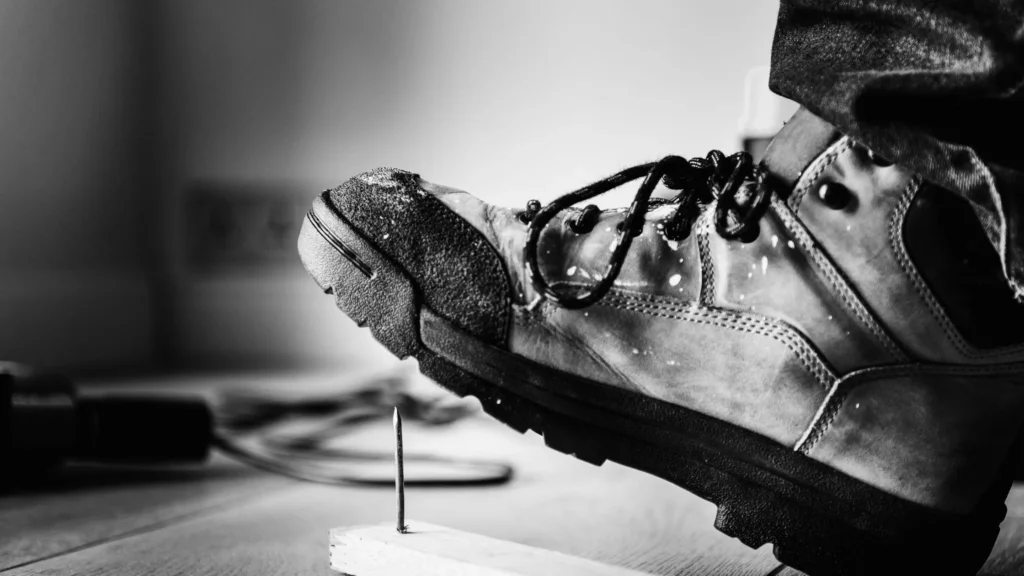
S3 is the most widely used safety shoe rating in the UAE and globally. It includes everything in S2, plus two critical additions: a penetration-resistant midsole that can withstand at least 1,100 newtons of force (protecting against nails and sharp objects on the ground), and a cleated outsole for better grip on uneven surfaces.
Best for: Construction sites, logistics, outdoor work, road works, and general industrial use. S3 is the UAE industry standard minimum for most hazardous environments.
S4 — Safety Level 4
S4 shoes shift to a completely different construction. Instead of leather or fabric, the entire shoe is made from rubber or polymer materials. This makes the shoe fully waterproof by design. S4 includes antistatic properties and energy-absorbing heel, but does not include a penetration-resistant midsole.
Best for: Agriculture, chemical plants, wet outdoor environments, and water treatment facilities.
S5 — Safety Level 5
S5 takes S4’s fully waterproof polymer construction and adds a penetration-resistant midsole and a cleated outsole. This makes S5 the rubber-boot equivalent of S3 — maximum outdoor and chemical environment protection combined with anti-penetration safety.
Best for: Heavy outdoor work, oil and gas field operations, agriculture with sharp debris, and highly chemical-exposed environments.
S6 — Safety Level 6
S6 combines the features of S3 with an additional waterproof lining inside the shoe. Unlike S2 and S3, which only resist water from the outside, S6 has an inner membrane (similar to Gore-Tex) that prevents water from reaching the foot even if the outer material is wet.
Best for: UAE outdoor sites during rain, environments with standing water, and workers who spend extended time in wet conditions.
S7 — Safety Level 7
S7 is the highest safety footwear rating in the EN ISO 20345 standard. It combines everything in S5 — including the full rubber or polymer construction and penetration-resistant midsole — with a waterproof inner lining. This is the most complete protection available in a certified safety shoe.
Best for: Maximum hazard environments, heavy industrial operations, and workplaces combining chemical, waterproof, and penetration hazards simultaneously.
Additional Marking Codes Explained
After the main S rating, you will often see additional letters on the shoe label. These codes describe specific protections that were independently tested and certified. Here is what each one means:
A — Antistatic The shoe allows a limited amount of static electricity to discharge safely through the sole. Antistatic shoes prevent the dangerous buildup of static that can cause sparks near flammable materials.
E — Energy Absorbing Heel The heel area absorbs impact energy, reducing stress on the heel, ankle, and lower back. This is especially important for workers who stand on hard floors for long shifts or who jump down from vehicles or platforms.
P — Penetration Resistant Midsole A rigid midsole (usually steel or Kevlar) is built into the shoe to stop sharp objects like nails, glass, or metal shards from piercing through the sole and into the foot. Required on all S3 and S5 rated shoes.
WR — Water Resistant Upper The upper material of the shoe has been treated or constructed to resist water penetration. Standard in S2 and above.
ESD — Electrostatic Discharge ESD shoes are specially designed to safely dissipate static electricity from the body. Unlike basic antistatic (A) shoes, ESD provides a controlled, measurable path for electricity to discharge. Essential in electronics manufacturing, IT server rooms, fuel stations, and laboratories.
HRO — Heat Resistant Outsole The outsole can withstand contact with surfaces up to 300°C without melting or deforming. This is a critical code for welders, foundry workers, and anyone working near extremely hot surfaces or molten materials.
HI — Heat Insulation of the Sole The sole provides insulation against heat conducted from the ground, tested at 150°C. This is useful for workers on hot floors, sun-baked outdoor surfaces in the UAE summer, or heated industrial floors.
CI — Cold Insulation The sole insulates the foot against cold, tested at minus 17°C. Relevant for workers in cold storage facilities, refrigerated warehouses, and freezer environments common in the UAE’s logistics and food distribution sector.
SRA — Slip Resistant on Ceramic Tile with Soapy Water The shoe has passed a slip resistance test on a wet ceramic tile floor with a sodium lauryl sulphate solution. Common requirement for hospitals, hotels, and kitchens.
SRB — Slip Resistant on Steel with Oil The shoe has passed a slip resistance test on a steel floor lubricated with oil. Relevant for garages, workshops, and light manufacturing.
SRC — Slip Resistant on Both Surfaces SRC is the combined and highest slip resistance rating. It means the shoe has passed BOTH the SRA and SRB tests. SRC is strongly recommended for most UAE workplaces. When in doubt, always choose SRC.
FO — Fuel and Oil Resistant Outsole The outsole does not swell, soften, or degrade when it comes into contact with fuel or oil. Standard on most S1 and above shoes. Especially important for petrol station workers, mechanics, and oil and gas personnel.
M — Metatarsal Protection An additional protective layer covers the top of the foot (the metatarsal bones) beyond the toecap area. Protects against heavy objects falling on the midfoot. Required in forestry, steel handling, and heavy manufacturing.
AN — Ankle Protection Additional padding and structure around the ankle area to protect against cuts, abrasions, and ankle-rolling injuries on uneven terrain.
CR — Cut Resistant Upper The upper material of the shoe is resistant to cutting. Essential for chainsaw operators, forestry workers, and those handling sharp metal or glass materials.
Real-World Label Example
Imagine a label that reads: S3 SRC ESD HRO
This shoe provides:
- S3: Waterproof upper, toecap, penetration-resistant midsole, cleated grip
- SRC: Slip resistant on both wet tiles and oily steel floors
- ESD: Electrostatic discharge protection
- HRO: Outsole resistant to 300°C heat contact
This combination is ideal for a worker in an oil refinery or welding workshop — protected against multiple hazards simultaneously.
Which Safety Shoe Code Is Right for Your Industry?
Here is a quick-reference guide for the most common industries in the UAE:
Construction Sites Recommended Rating: S3 SRC or S3 SRC P Why: Construction sites have nails, sharp debris, uneven ground, and wet or muddy surfaces. S3’s penetration-resistant midsole and cleated grip are essential. SRC protects against slipping on wet surfaces.
Oil and Gas Recommended Rating: S5 ESD FO HRO SRC Why: Oil and gas environments combine fuel exposure, heat, static electricity risks, and outdoor hazards. ESD prevents sparks near flammable gases. HRO handles heat from hot surfaces. FO resists fuel degradation.
Warehousing and Logistics Recommended Rating: S1 SRC or S3 SRC Why: Forklift traffic, heavy box drops, and polished or wet warehouse floors make toecap protection and SRC slip resistance essential. S3 is preferred for outdoor loading areas.
Electrical and Electronics Work Recommended Rating: S2 ESD or S1 ESD A Why: Electrostatic discharge is the primary hazard. ESD shoes protect sensitive equipment from static sparks. Non-metallic composite toecaps are preferred as they do not interfere with electromagnetic environments.
Healthcare and Hospitals Recommended Rating: S1 SRC A Why: Hospital floors — especially near operating theatres, wet areas, and kitchens — are major slip hazards. SRC is mandatory. Lightweight construction supports comfort during long shifts. Antistatic A code protects sensitive medical equipment.
Hospitality and Commercial Kitchens Recommended Rating: S2 SRA or S2 SRC Why: Kitchen floors are consistently wet and greasy. SRA provides slip resistance on wet ceramic surfaces. Water-resistant uppers handle the wet kitchen environment. Comfort and lightweight design matter for shift-long standing.
Welding and Metal Fabrication Recommended Rating: S3 HRO SRC Why: Hot metal sparks and pieces are a constant hazard. HRO protects the outsole from heat up to 300°C. The S3 midsole stops sharp metal shards from piercing the sole. SRC protects on oil-covered workshop floors.
Agriculture and Outdoor Environments Recommended Rating: S4 or S5 Why: Wet fields, chemical fertilisers, and sharp debris make a fully waterproof rubber boot (S4 or S5) the right choice. The all-polymer construction handles chemical exposure and complete waterproofing.
Cold Storage and Refrigeration Recommended Rating: S3 CI SRC Why: Cold insulation (CI) is critical in freezer environments. SRC prevents slipping on icy or wet cold store floors. S3 toecap and midsole protect against heavy pallet or forklift hazards common in refrigerated warehouses.
UAE Laws and Safety Footwear Compliance
Workplace safety in the UAE is regulated by a clear framework of laws and standards. Understanding these regulations is essential for every employer operating in Dubai, Abu Dhabi, Sharjah, or any other emirate.
UAE Federal Labour Law
Federal Law No. 8 of 1980, and its subsequent amendments, requires all UAE employers to provide workers with appropriate personal protective equipment for their job. This includes safety footwear for all workers in roles with foot hazard exposure. Employers who fail to provide proper PPE may face fines, legal liability, and mandatory work stoppages.
OSHAD — Abu Dhabi Occupational Safety and Health Centre
OSHAD governs workplace health and safety in the Emirate of Abu Dhabi. It sets specific minimum standards for PPE in sectors including construction, oil and gas, and manufacturing. For footwear, OSHAD aligns with EN ISO 20345 standards and specifies minimum S-class ratings by industry type. Safety audits routinely check whether workers are wearing correctly rated footwear.
CICPA — Critical Infrastructure and Coastal Protection Authority
CICPA regulates safety on major infrastructure projects across Dubai and the UAE. On all CICPA-registered construction and infrastructure sites, certified safety footwear — at minimum S3 rated — is a mandatory requirement. Site access may be refused to workers who arrive without compliant footwear.
Who Is Responsible?
Under UAE law, the employer is responsible for providing safety footwear — not the worker. If a worker is injured because they were not given proper certified footwear, or because they were given an incorrect rating for their hazard environment, the employer may face significant legal consequences. Providing certified, correctly coded safety footwear is not optional — it is a legal and ethical obligation.
How to Read a Safety Shoe Label — Step by Step
When you pick up a pair of safety shoes, here is how to read the label correctly:
Step 1: Look for the EN ISO 20345 mark. If it is not there, the shoe is not certified.
Step 2: Find the S rating. This tells you the main protection class (SB, S1, S2, S3, S4, S5, S6, or S7).
Step 3: Read the additional codes that follow the S rating. Each letter or abbreviation describes an extra protection feature.
Step 4: Match the codes to your workplace hazards. Use the industry guide in Section 5 to confirm the right rating for your job.
Step 5: Check the fit. A certified shoe that fits poorly still creates risks through discomfort, fatigue, and instability. Try the shoe on with the socks you will wear at work.
Common Mistakes to Avoid When Buying Safety Shoes
Mistake 1: Buying the cheapest certified shoe without checking the rating
A shoe can carry EN ISO 20345 certification and still be completely wrong for your job. An S1-rated shoe is certified — but it will not protect a construction worker from nail penetration. Always check the S rating and the additional codes, not just the certification mark.
Mistake 2: Assuming all safety shoes look the same on the inside
Two pairs of safety shoes can look identical from the outside but have completely different protection levels inside. One may have a steel midsole, the other may not. Always read the label — never judge a safety shoe by its appearance alone.
Mistake 3: Ignoring SRC slip resistance
Many workplace injuries in the UAE — especially in kitchens, hospitals, and logistics centres — are caused by slipping, not falling objects. If your shoe does not carry SRC or at minimum SRA, you are not protected against one of the most common workplace injury causes.
Mistake 4: Wearing safety shoes past their safe lifespan
Safety shoes do not last forever. Most shoes used in heavy daily industrial work last between six and twelve months before the midsole compresses, the outsole wears down, or the upper starts to crack. A visually worn shoe offers little real protection. Replace safety shoes regularly and check them monthly for signs of wear.
Mistake 5: Buying uncertified shoes from informal markets
Dubai and the UAE have a significant market for cheap, uncertified safety shoes that carry fake or misleading labels. Buying from uncertified suppliers puts workers at risk and exposes employers to legal liability. Always purchase from authorised suppliers who provide genuine EN ISO 20345 certified footwear.
Frequently Asked Questions
What does EN ISO 20345 mean on safety shoes?
EN ISO 20345 is the international standard for safety footwear. Any shoe carrying this certification has been independently tested to meet minimum protection requirements — including a toecap that resists 200 joules of impact force. If a shoe does not carry this mark, it is not a certified safety shoe.
What is the difference between S1, S2, and S3?
S1 gives you a toecap, antistatic properties, energy-absorbing heel, and oil-resistant sole. S2 adds water resistance to the upper. S3 builds on S2 by adding a penetration-resistant midsole and cleated outsole — making it the most complete and most popular option for UAE workplaces.
Are employers in the UAE required to provide safety shoes?
Yes. Under UAE Federal Labour Law and OSHAD regulations, employers must provide appropriate PPE — including safety footwear — to workers in hazardous roles. Failure to do so is a legal violation that can result in fines, liability, and operational penalties.
What does ESD mean on safety shoes?
ESD stands for Electrostatic Discharge. ESD shoes safely channel static electricity from the body through the sole to the ground, preventing sparks. They are essential in electronics manufacturing, IT environments, fuel stations, and laboratories.
What is the difference between SRA, SRB, and SRC?
SRA means the shoe passed a slip resistance test on wet ceramic tile with soapy water. SRB means it passed on an oily steel surface. SRC means it passed both tests — making it the highest and most recommended slip resistance rating for UAE workplaces.
How long do safety shoes last?
Safety shoes used in heavy industrial work typically last six to twelve months. In lighter use, they may last two to three years. Replace your shoes if the toecap is cracked, the midsole feels compressed, the outsole is worn smooth, or the upper is torn. Worn safety shoes offer far less protection than their rating suggests.
Are composite toecaps as safe as steel toecaps?
Yes — when certified to EN ISO 20345, composite toecaps (made from Kevlar, carbon fibre, or fibreglass) provide identical 200-joule impact protection as steel. Composite toecaps are also lighter, non-metallic (better for ESD environments and metal detector checkpoints), and do not conduct heat or cold — an important advantage for workers in the UAE’s extreme temperatures.
Which safety shoe is best for construction in Dubai?
For construction in Dubai, S3 SRC is the minimum recommended rating. If workers are near welding or very hot surfaces, add HRO. If the site involves significant electrical or static hazards, add ESD. For sites with specific CICPA requirements, confirm the exact specifications with your site safety officer.
Conclusion
Safety footwear codes are not complicated once you understand the system. Every code on the label of a certified safety shoe is there for a reason — to tell you, clearly and transparently, exactly what that shoe can and cannot protect you from.
The key takeaways from this guide:
Every safety shoe must carry EN ISO 20345 certification. Without it, the shoe has not been independently tested. The S rating tells you the core protection level — SB is the minimum, S7 is the maximum. Additional codes like SRC, ESD, HRO, and P describe specific protections for specific hazards. Match your shoe code to your workplace hazard — not to your budget or your preference. UAE employers are legally required to provide certified, correctly rated footwear to their workers. And finally, replace safety shoes regularly — a worn shoe is not a safe shoe, regardless of its original certification.
At Safe Gear Dubai, we supply the full range of EN ISO 20345 certified safety footwear — from S1 to S7, with every combination of SRC, ESD, HRO, CI, and specialist codes. We serve construction companies, oil and gas operators, hospitals, hotels, warehouses, and manufacturing facilities across Dubai, Abu Dhabi, Sharjah, and the wider UAE.
Safe Gear Dubai — Certified Safety Equipment Supplier, UAE. Contact us for bulk orders, site assessments, and PPE consultations