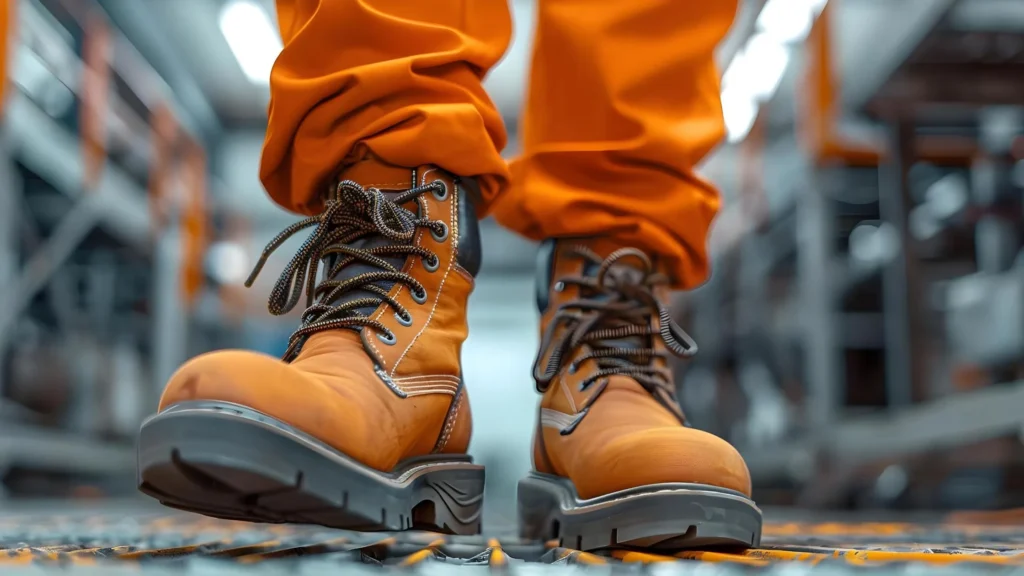
Most workers in Dubai replace their safety shoes too late — or spend too little on care and pay for it with a shorter lifespan. This guide tells you exactly how long your safety shoes should last, what kills them faster in the UAE climate, and the simple weekly routine that can double their lifespan.
The Real Cost of Ignoring Your Safety Shoes
Here is something most workers don’t think about: a pair of safety shoes that cost AED 300 might protect you for 18 months with proper care. The same pair, ignored, wears out in 6 months — and then it stops protecting you long before you replace it.
That’s not just a money problem. It’s a safety problem.
Safety shoes with certified SRC soles reduce slip-related incidents by 64%. But that protection depends entirely on the sole being in good condition. A worn-out sole gives you almost no benefit — yet most workers keep wearing the shoes anyway because they look okay on the outside.
The global safety footwear market is valued at USD 10.5 billion in 2024, which tells you one thing clearly: serious industries take foot protection seriously. You should too.
This guide covers everything UAE workers and safety managers need to know — from how long safety shoes actually last in Dubai’s heat, to the weekly care habits that keep your EN ISO 20345 certification valid and your feet protected.
Who This Guide Is For
You work on a construction site, in a factory, a warehouse, an oil and gas facility, or any industrial environment across the UAE. You are on your feet for 8 to 12 hours a day. You wear safety shoes because you have to — or because you’ve learned the hard way that your feet need real protection.
Maybe you’re a site supervisor buying PPE for a team of 20. Maybe you’re an individual worker who just bought your first pair of Puma safety shoes and wants them to last. Either way, this guide is written for you.
You don’t need to be a safety expert to follow this. You just need to spend 10 minutes a week on your shoes.
How Long Do Safety Shoes Actually Last in the UAE?
This is the first question most people ask — and the honest answer is: it depends.
Safety shoes should be replaced every 6 to 12 months for heavy use, or up to two years for light use.
But here’s what those numbers look like in real UAE working conditions:
| Work environment | Expected lifespan |
|---|---|
| Construction site (Dubai summer) | 6–9 months |
| Oil & gas / offshore (chemical exposure) | 6–12 months |
| Warehouse / logistics (indoor, AC) | 12–18 months |
| Manufacturing (factory floor) | 10–14 months |
| Light industrial / office visits | 18–24 months |
Top-tier manufacturers like Red Wing and Timberland PRO produce safety shoes that extend lifespan to 12–18 months under normal use. Premium brands like Puma Safety use similar engineering standards — which means a AED 350 pair of Puma Velocity 2.0 shoes, cared for properly, costs you far less per month than cheap alternatives you replace every few months.
Safety boots costing AED 50 with a service life of two months only look profitable on paper. Over the course of a year, the company goes through five to six purchasing cycles, spending resources on logistics and administration.
The maths are simple: spend more once, care for them properly, and you spend less overall — while staying safer the entire time.
Why Dubai’s Climate Destroys Safety Shoes Faster
The UAE presents conditions that no safety shoe manufacturer in Europe or North America designs for. You need to understand these factors to fight them.
1. Extreme heat (April–October)
Temperatures in Dubai routinely hit 40–48°C between April and October. High temperatures accelerate leather drying and cracking, particularly during outdoor exposure. This happens to the upper material of your shoes — the visible part — but also to the adhesives that bond the sole to the upper. When that glue breaks down, the sole starts to peel, and your shoe fails structurally — not just cosmetically.
2. Fine desert sand and dust
Sand is an abrasive. It enters every crease, stitch line, and seam of your shoe. Fine sand and dust penetrate crevices, soles, and stitch lines, gradually wearing down materials. On a construction site or outdoor facility, your shoes collect sand daily. Without regular brushing, this grinds the material from the inside out.
3. Rapid temperature changes
You walk from a 48°C site into a 20°C air-conditioned site office, then back out again. This cycle happens dozens of times a week. The rapid temperature fluctuations caused by indoor air conditioning can dry adhesives and leather. Over time, this weakens both the upper and the bond between the upper and the sole.
4. Sweat and humidity in enclosed shoes
Your feet sweat heavily in UAE working conditions. Sweat is slightly acidic. Over months, that moisture and acidity degrade the insole, the lining, and even the structural foam inside the shoe. Occasional humidity promotes mildew and unpleasant odors in unventilated shoes. When the insole breaks down, your ankle and arch support disappears — and so does your protection against fatigue-related accidents.
The 5 Biggest Mistakes UAE Workers Make With Safety Shoes
Mistake 1: Never cleaning them
Dust and dried sweat don’t just look bad. They break down materials. Workers who wipe their shoes after every shift keep the leather supple and the soles intact. Workers who clean their shoes only when they look embarrassingly dirty pay with a lifespan cut in half.
Mistake 2: Drying them with direct heat
After a sweaty day, putting your shoes next to a heater, under direct sunlight, or using a heat gun to dry them feels logical. It destroys your shoes. Leaving shoes by a furnace or under the heat of a blow dryer can dry out the leather, causing cracking and damage. Always let leather safety shoes air dry naturally.
Mistake 3: Wearing the same pair every day
Your shoes need time to dry out fully between shifts. Wearing the same pair daily means the interior never fully recovers from sweat exposure. Having an alternate pair of shoes allows rotation so shoes can rest and dry, minimising sweat accumulation and extending lifespan. If budget allows, owning two pairs and rotating them adds months to both pairs.
Mistake 4: Ignoring the insoles
The original insoles in most safety shoes are functional but basic. Once they compress and flatten — usually within 4–6 months of heavy use — you lose cushioning and arch support. Replace insoles independently every 4–6 months instead of replacing the whole shoe. This is the cheapest single maintenance step that extends shoe life and prevents foot fatigue.
Mistake 5: Replacing shoes based on appearance only
This is the most dangerous mistake. The visible upper of a safety shoe can look acceptable while the sole has lost its slip resistance, the toe cap lining has cracked, or the midsole cushioning has completely compressed. Always inspect the full shoe — sole, interior, and protective elements — not just the outer surface.
Your Complete Safety Shoe Care Routine
After every shift (5 minutes)
Step 1: Remove and inspect
Take your shoes off and set them upright in a ventilated area — not in a closed locker. Remove the insoles and let them air separately. Look for any cuts, tears, or unusual sole wear.
Step 2: Brush off dust and sand
Use a dry stiff-bristle brush to remove sand and debris from the upper, seams, and sole edges. In Dubai’s sandy environment, this single step prevents significant long-term abrasion damage.
Step 3: Wipe the upper
Use a slightly damp cloth to wipe down the leather or synthetic upper. Remove any chemical residue, cement, oil, or grease immediately — these degrade materials quickly if left to sit.
Weekly (15 minutes)
Step 1: Deep clean the upper
Apply a mild soap solution with a soft brush to the leather upper. Work in circular motions. Remove all soap residue with a clean damp cloth. For synthetic uppers, use a mild detergent diluted in cold water. After cleaning, let the shoes dry naturally by exposing them to air — heat will damage the structure.
Step 2: Condition leather uppers
Leather shoes require conditioning every two weeks to keep the surface soft and fresh. Apply a quality leather conditioner in circular motions and let it absorb fully before the next wear. In Dubai’s extreme heat, conditioning is not optional — it is what prevents the cracking that splits leather uppers and exposes the interior.
Step 3: Clean the sole
Use a stiff brush and water to remove embedded sand and debris from the sole pattern. The grip channels in a safety shoe sole are what provide slip resistance — blocked channels provide significantly less grip, particularly on wet or oily surfaces.
Step 4: Check laces and eyelets
Replace worn or fraying laces. Damaged laces affect ankle support, which affects how the shoe sits on your foot and how the toe cap aligns with your toes.
Monthly (20 minutes)
Step 1: Apply protective spray
Apply a leather protector spray before wearing shoes outdoors. Reapply every few months or after cleaning. This creates a barrier against sand, moisture, and UV degradation — all three of which are extreme in the UAE.
Step 2: Full structural inspection
Inspect the shoe methodically:
- Sole: Press the sole firmly — does it feel compressed and thin? Does the heel area show significant wear? Is the tread pattern still visible?
- Upper: Check all stitch lines for separation. Run your finger along seams to feel for gaps.
- Toe cap area: Press the upper over the toe cap — does it feel solid, or has the lining cracked and collapsed?
- Interior: Check the insole for excessive compression and the interior lining for breakdown or holes.
- Closure: Check that laces, buckles, or velcro closures still hold firmly.
Step 3: Sole edge check
Look at the edge where the upper meets the sole. Any visible separation, even minor, signals that the adhesive is failing. Catch this early and a cobbler can re-bond the sole. Ignore it and you lose the entire shoe.
How to Store Safety Shoes in the UAE
Storage matters more than most workers realise — especially through Dubai’s 5-month summer season.
Do this:
- Store in a cool, ventilated area away from direct sunlight
- Use a shoe rack that allows air circulation on all sides
- Use silica gel packs inside shoes to absorb moisture and prevent odors
- Store with insoles removed to allow interior ventilation
- If you don’t wear a pair for weeks, stuff them with newspaper to maintain shape
Never do this:
- Store in a sealed plastic bag or airtight container (traps moisture, causes mould)
- Leave on a windowsill or near a site-office window in direct sun
- Stack shoes on top of each other — this deforms the upper
- Store wet or damp shoes in a locker without drying first
8 Signs You Must Replace Your Safety Shoes Now
Don’t wait for all 8. Even one of these signs means the protective function of your shoes has been compromised.
1. The sole is worn smooth
You can no longer feel a defined tread pattern under your thumb. Slip resistance is gone. On oily or wet surfaces, these shoes are now a hazard.
2. The sole has separated from the upper
Any gap between the sole and upper — even at the toe or heel only — means the shoe’s structural integrity is broken. It will not protect against compression or impact the way a bonded shoe would.
3. The upper has cracks that expose the interior
Cracks in leather that reach through to the lining allow water, chemicals, and sharp objects to reach your foot. The shoe no longer meets EN ISO 20345 protection requirements.
4. The heel collapses inward
Stand the shoe on a flat surface. If the heel leans visibly inward, the midsole has compressed unevenly. This affects ankle stability and significantly increases sprain risk.
5. The toe cap area has deformed
Press the area above your toes. If the upper material has sunken toward the cap, the lining has failed. The cap may still be intact, but it may no longer sit in the correct position to protect your toes from a direct impact.
6. You feel pain or fatigue earlier than usual
Foot fatigue setting in earlier than it used to is a direct sign that your insole cushioning and midsole support have broken down — even if the shoe looks acceptable from the outside.
7. The shoe smells despite cleaning
Persistent odour that does not resolve after cleaning means the interior lining has broken down and is harbouring bacteria. This is a hygiene issue and also signals that the shoe structure has deteriorated.
8. You’ve had the shoes longer than 18 months of daily heavy use
Good quality safety footwear should last at least as long as the manufacturer’s warranty, which in some cases is as much as 18 months. Beyond 18 months of daily heavy use in construction or industrial environments, replace regardless of appearance. The protective materials degrade from the inside in ways you cannot see.
Does the EN ISO 20345 Certification Expire?
Yes — but not on paper. It expires in practice.
EN ISO 20345 is the international standard that governs safety footwear protection levels. Your shoes meet this standard when they are new. But the standard’s protection requirements — impact resistance, compression resistance, slip resistance, and puncture resistance — all depend on the physical condition of the shoe.
A pair of safety shoes that certified as S3 when new may no longer perform to S3 standards after 12 months of construction site use. The certification doesn’t disappear from the label, but the actual protection does.
A UAE University study found that around two-thirds of hospital visits for injuries at building sites involved incidents related to a lack of PPE or unsuitable PPE. Worn-out safety shoes fall into the category of unsuitable PPE — even if they technically are PPE.
Bulk Orders and Corporate Replacement Schedules
If you manage a team, a site, or a company fleet of safety shoes, the best approach is a scheduled replacement programme rather than reactive replacement.
Here’s a simple framework for UAE site managers:
Every 6 months: Replace shoes for workers in construction, oil & gas, and outdoor heavy industrial roles regardless of visible condition.
Every 12 months: Replace shoes for warehouse, logistics, and light manufacturing workers. Inspect insoles every 6 months and replace if compressed.
Every 18–24 months: Replace shoes for supervisory or mixed indoor/outdoor roles where daily wear intensity is lower.
Building a replacement schedule into your MOHRE compliance documentation also protects your company. UAE Labour Law No. 33 of 2021 covers safe workplace requirements, PPE provisions, and risk prevention measures. Worn-out PPE creates both safety liability and regulatory exposure.
Safe Gear supplies bulk and corporate PPE orders across all emirates — contact us at info@safegear.ae or call +971 58 572 8084 for bulk pricing and delivery timelines.
The Best Safety Shoes for Longevity in UAE Conditions
Not all safety shoes age equally in Dubai’s climate. The materials matter enormously.
Leather safety shoes take up 46.8% of the market by 2025 — the choice of many in industrial environments for their durability, wear resistance, flexibility, and ventilation. Leather is best suited to dealing with impact, compression and puncture hazards.
For UAE conditions specifically, look for these features when buying:
- Full-grain leather upper — most resistant to heat, abrasion, and sand
- Polyurethane (PU) or dual-density PU/PU sole — resists compression better than rubber alone in sustained heat
- EN ISO 20345 S3 rating — includes water resistance, which matters for oil and chemical exposure on UAE sites
- ESD (electrostatic discharge) protection — essential for manufacturing and electronics environments
- HRO (heat resistant outsole) — required for oil & gas and welding environments where ground temperatures are extreme
Puma Safety shoes — all of which Safe Gear stocks — use BASF-developed PU compounds and Vibram-inspired sole constructions that significantly outperform budget alternatives in sustained-heat durability testing.
Quick Reference: Safety Shoe Care Calendar
| Frequency | Action |
|---|---|
| After every shift | Brush off sand, wipe upper, air insoles |
| Weekly | Deep clean upper, condition leather, clean sole channels |
| Every 2 weeks | Re-condition leather (Dubai summer: increase to weekly) |
| Monthly | Apply protective spray, full structural inspection |
| Every 4–6 months | Replace insoles |
| Every 6–12 months | Replace shoes (heavy use) |
| Every 12–24 months | Replace shoes (light/moderate use) |
Summary: Protect Your Shoes So They Can Protect You
Your safety shoes are not just footwear. They are the only thing between your feet and the full weight of a falling object, a hot surface, an oil-slicked floor, or a steel edge. They protect you every single shift — but only if you maintain them.
The core rules for UAE workers are simple:
- Clean after every shift — never let sand and sweat sit overnight
- Condition leather weekly — Dubai heat dries leather fast
- Air dry naturally — never use direct heat
- Store in a ventilated, cool space — not a hot locker or plastic bag
- Inspect monthly — look at the sole, the upper, and the interior
- Replace on schedule — don’t wait until they fall apart
The shift from treating consequences to preventing risks is a sign of a mature business in the UAE. Investing in high-quality protective footwear is a manageable financial tool that directly affects a company’s stability and long-term profits.
Shop Safety Shoes at Safe Gear
Safe Gear stocks the full range of Puma Safety shoes in Dubai — including the Velocity 2.0, Condor, Fuse Motion, and Elevate Knit models. All shoes are ISO/EN certified and available for delivery across the UAE with Cash on Delivery.
Frequently Asked Questions
How often should I replace safety shoes in Dubai?
For construction and heavy industrial use in Dubai, replace every 6–9 months. For warehouse and indoor roles, replace every 12–18 months. Dubai’s heat and sand accelerate wear significantly compared to European conditions.
Can I machine wash my safety shoes?
No. Machine washing damages the adhesive bonding the sole to the upper, degrades leather, and can compromise the structural integrity of the toe cap lining. Always hand clean with a soft brush, mild soap, and a damp cloth.
How do I stop my safety shoes from smelling in the UAE heat?
Remove insoles after every shift and let both the shoe and insole air dry separately. Use silica gel packs inside the shoe during storage. Replace insoles every 4–6 months — persistent odour after cleaning is a sign the insole lining has broken down and bacteria have taken hold.
Do Puma safety shoes last longer than budget brands?
Yes, consistently. Premium safety shoes from brands like Puma use higher-grade PU soles, full-grain leather uppers, and reinforced stitching that withstands UAE conditions significantly better. A AED 350 Puma shoe that lasts 15 months costs less per month than a AED 80 shoe replaced every 3 months — and keeps you safer throughout.
What is the EN ISO 20345 standard, and does it have an expiry?
EN ISO 20345 sets the minimum protection requirements for safety footwear including impact resistance, compression resistance, and slip resistance. The certification applies to new shoes. As shoes wear, their actual protection level drops below the certified standard — which is why replacement schedules matter. The label doesn’t change, but the protection does.
Do I need to condition safety shoes in winter in the UAE?
Yes. UAE “winter” (November–March) still brings low humidity and dry air indoors due to air conditioning. Leather safety shoes still lose moisture and require conditioning every 2–3 weeks year-round. During summer (April–October), increase conditioning to weekly.