UAE workplace safety regulations are built on Federal Decree-Law No. 33 of 2021, enforced primarily by MOHRE, with additional layers from OSHAD in Abu Dhabi and Dubai Municipality in Dubai. Every employer in the country must provide a safe working environment, supply proper PPE, and follow sector-specific safety codes. Violations can lead to fines starting at AED 5,000 and reaching AED 1,000,000 per offense, multiplied by the number of affected workers.
This guide breaks down what employers and workers in the UAE need to know in 2026, from the legal framework to PPE rules, penalties, and heat stress requirements.
What Is the Main Law Governing Workplace Safety in the UAE?
Federal Decree-Law No. 33 of 2021 is the main law governing workplace safety in the UAE. It replaced the older Federal Law No. 8 of 1980 and came into effect on February 2, 2022. The law is commonly known as the UAE Labour Law.
Article 13 of this law places a direct duty on employers. Employers must provide a safe and appropriate working environment. Employers must protect workers from occupational injuries and diseases. Employers must place instructional safety boards at the workplace. Employers must provide safety training relevant to each role.
The law applies to all private sector employers and employees in the UAE. This includes UAE nationals and foreign workers. Free zones such as the DIFC and Abu Dhabi Global Market follow their own separate employment frameworks instead.
Enforcement sits with the Ministry of Human Resources and Emiratisation, known as MOHRE. MOHRE inspectors can enter and inspect any workplace without prior notice. In 2026, these inspections rely more heavily on a digital platform that uses AI-based risk profiling to target high-risk sectors like construction, manufacturing, and logistics.
Who Enforces UAE Workplace Safety Regulations ?
MOHRE enforces workplace safety rules at the federal level, while Abu Dhabi and Dubai each add their own local safety frameworks. This layered system means one federal law applies everywhere, but each emirate expects additional compliance on top of it.
| Authority | Coverage | Framework |
| MOHRE | Federal, all emirates | Federal Decree-Law No. 33 of 2021 |
| OSHAD (Abu Dhabi) | Abu Dhabi | OSHAD-SF, aligned with ISO 45001:2018 |
| Dubai Municipality | Dubai | Dubai Municipality HSEMS and Construction Safety Code |
| Sharjah OSH (OSHJ) | Sharjah | Sector-specific safety guidelines |
| Civil Defence | All emirates | Fire and life safety compliance |
A company operating only under federal rules can still fail an emirate-level inspection. Abu Dhabi’s OSHAD-SF is particularly strict about documented risk assessments, worker participation records, and management-of-change procedures. Dubai Municipality expects compliance with its own Construction Safety Code alongside the UAE Fire and Life Safety Code.
Businesses expanding from one emirate to another often assume their existing safety policy transfers directly. It usually does not, because OSHAD and Dubai Municipality each maintain separate audit checklists and documentation standards.
What Are the OSHAD Safety Standards in Abu Dhabi?
OSHAD safety standards are a set of mandatory occupational health and safety requirements enforced across Abu Dhabi through the OSHAD-SF framework. OSHAD stands for the Occupational Safety and Health Center, operating under Abu Dhabi’s Department of Municipalities and Transport.
The framework requires a documented risk assessment for every work activity. It requires regular internal and external safety audits. It requires a formal health and safety management plan for each establishment.
In 2025 and 2026, OSHAD-SF mechanisms were updated to align with ISO 45001:2018. This update strengthened three areas specifically. Leadership commitment now requires visible, documented senior management involvement in safety decisions. Worker participation now requires formal channels for employees to raise hazard concerns. Management of change now requires a documented process before altering equipment, processes, or site conditions.
OSHAD inspectors have the authority to shut down non-compliant sites. This applies to construction sites and industrial facilities that fail to meet risk assessment or audit requirements. Companies operating solely in Dubai and expanding into Abu Dhabi frequently underestimate this level of scrutiny, which can delay project timelines.
What Are MOHRE’s Health and Safety Requirements for Employers?
MOHRE requires employers to prevent occupational hazards, provide PPE, deliver safety training, and report all workplace injuries within a set timeframe. These obligations apply to every private sector employer in the UAE, regardless of company size.
Employers must meet the following core requirements under MOHRE:
- Provide the equipment necessary to protect workers from occupational injuries and diseases
- Display instructional safety boards and awareness materials at the workplace
- Deliver appropriate safety training before workers begin high-risk tasks
- Conduct periodic evaluations to confirm ongoing compliance
- Report any workplace injury or death to MOHRE within 48 hours
Companies with 50 or more workers face an additional requirement. They must maintain a dedicated system to monitor work-related injuries and occupational diseases, including a record of incidents and an inventory of hazardous activities.
Any industrial establishment, and any construction employer with 100 or more workers, must appoint a technically qualified Occupational Health and Safety Officer under Ministerial Resolution No. 44 of 2022. This officer is responsible for hazard prevention and supervising safety compliance on-site.
What PPE Is Required Under UAE Law?
UAE law requires employers to supply personal protective equipment suited to each worker’s specific job risks, at no cost to the employee. This obligation falls under Article 13 of the Labour Law and is reinforced by emirate-level safety codes.
Common PPE categories mandated across UAE workplaces include:
- Head protection, such as safety helmets on construction and industrial sites
- Eye and face protection for welding, grinding, or chemical handling
- Hand protection, including cut-resistant or chemical-resistant gloves
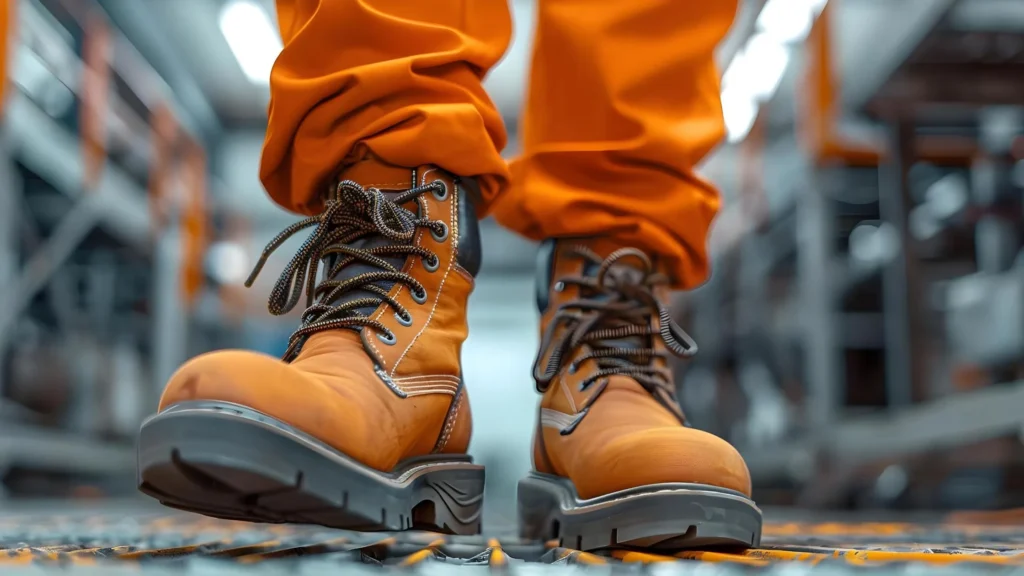
- Foot protection, such as steel-toe safety boots
- Respiratory protection where dust, fumes, or chemical exposure is present
- Fall protection, including harnesses for work at heights above 1.8 meters
- High-visibility clothing for workers near vehicles or machinery
Employers are also responsible for confirming workers actually use the PPE correctly, not just supplying it. Failure to train workers on proper PPE use is treated the same as failing to supply the equipment during an inspection.
Fall protection carries specific technical requirements. Scaffolding must meet British Standard BS 1139 or European Norm EN 12811. Excavation work requires edge protection and safe access under MOHRE workplace safety standards.
What Are the Penalties for Workplace Safety Violations in the UAE?
Penalties for workplace safety violations in the UAE range from AED 5,000 to AED 1,000,000 per offense, depending on the severity and the number of workers affected. Federal Decree-Law No. 9 of 2024 raised the penalty ceiling significantly starting August 31, 2024.
| Violation Type | Penalty Range |
| Failure to follow OHS standards or procedures | AED 10,000 per case |
| Heat stress midday ban violation | AED 5,000 per worker, up to AED 50,000 |
| Non-compliant worker accommodation | AED 100,000–300,000 |
| Serious safety and labour violations (post-2024) | AED 100,000–1,000,000, multiplied by affected workers, capped at AED 10,000,000 |
Fines are only one consequence. MOHRE can suspend a company’s work permits, freeze its establishment file, or downgrade its compliance classification, which makes future permit approvals more expensive. In Dubai, Law No. 7 of 2025, effective January 8, 2026, added contractor licence suspension of up to one year for serious safety non-compliance.
If a workplace accident causes death, the case escalates beyond MOHRE. Police open an automatic investigation. Responsible managers can face a travel ban while the investigation continues, and criminal court referral can bring at least one year of imprisonment for serious violations.
What Are Employer Safety Obligations in the UAE?
Employer safety obligations in the UAE center on preventing hazards before they cause harm, not just reacting after an incident. These obligations apply from the moment a worker is hired through daily site operations.
Core employer obligations include:
- Identify workplace hazards through documented risk assessments
- Implement engineering controls to reduce or eliminate identified risks
- Provide PPE suited to each specific job function
- Deliver documented, dated, and signed safety training records
- Maintain safe equipment and premises through regular inspections
- Report any injury or death to MOHRE and local police within 24 hours
- Provide on-site first aid facilities and access to medical care
Documentation is an employer’s primary defense in any dispute or inspection. Training records that are not documented are treated by inspectors and courts as training that never happened.
Workers also carry responsibilities under the same law. They must follow safety instructions, use provided protective equipment correctly, and report unsafe conditions. Workers have the legal right to refuse work that poses a direct threat to their life or health, without facing disciplinary action.
How Does the UAE Regulate Heat Stress and Outdoor Work?
2026 heat stress rules expanded to include Wet Bulb Globe Temperature monitoring for outdoor sites. Employers must document acclimatization schedules for new outdoor workers. Employers must provide heat stress training for all staff working outdoors.
Delivery riders fall under a stricter version of this rule and cannot work outdoors at all during ban hours. The UAE has installed more than 12,000 air-conditioned rest stations nationwide to support this group during the summer months.
A small number of jobs are exempt for technical or safety reasons, such as asphalt laying already in progress. Even exempt employers must still provide shade, drinking water, and hydration support. Violating the midday ban costs AED 5,000 per worker, rising to AED 50,000 when multiple workers are affected.
How Can Employers Stay Compliant With UAE Workplace Safety Rules in 2026?
Employers can stay compliant in 2026 by treating safety as an ongoing documented process rather than a one-time policy. MOHRE’s shift to AI-powered, data-driven inspections means gaps surface faster than in previous years.
Practical steps for 2026 compliance:
- Review and update internal safety policies against current Labour Law requirements
- Re-run risk assessments instead of relying on outdated ones
- Keep training records dated, signed, and centrally stored
- Confirm PPE supply and correct usage through documented checks
- Register worker accommodation details where required, for establishments with 50 or more workers earning AED 1,500 or less monthly
- Align emirate-specific obligations separately for Abu Dhabi, Dubai, and Sharjah operations
Businesses supplying certified PPE, conducting safety audits, or managing site compliance across the UAE can reduce this administrative load by working with a specialist. Speak to Safe Gear’s safety compliance team for PPE sourcing and workplace safety support tailored to your sector.
Disclaimer: Penalty amounts above are based on published UAE Labour Law provisions and available reporting as of 2026. Fines are updated periodically and can vary by case, sector, and emirate. Employers should confirm current figures directly with MOHRE or a licensed UAE legal advisor before making compliance decisions.
Frequently Asked Questions
What is the main law for workplace safety in the UAE?
Federal Decree-Law No. 33 of 2021 is the main law. It requires employers to provide a safe working environment and appropriate PPE.
Who enforces workplace safety in the UAE?
MOHRE enforces workplace safety at the federal level. OSHAD enforces additional standards in Abu Dhabi, and Dubai Municipality enforces additional standards in Dubai.
What is the fine for not following occupational health and safety standards?
The fine is AED 10,000 per case for failing to follow OHS standards, and fines for broader Labour Law safety violations range up to AED 1,000,000.
When does the UAE midday work ban apply?
Employers must report a workplace injury or death to MOHRE within 48 hours, and to local police within 24 hours.