Quick Answer: What to Look For
The best safety helmet for UAE construction sites must meet EN 397:2025 or ANSI Z89.1 and carry an ESMA certification mark. For most outdoor roles in UAE heat, choose an HDPE shell, vented design, ratchet suspension, and Class E (electrical) rating. Replace helmets every 3–5 years, or immediately after any impact.
Why Head Protection Is Non-Negotiable on UAE Construction Sites
Every day, thousands of construction workers across Dubai, Abu Dhabi, and Sharjah enter worksites where a single falling object or accidental impact can cause a traumatic brain injury (TBI) — or worse. According to global construction safety data, head injuries cause roughly 25% of all fatal workplace accidents. In UAE’s rapidly expanding construction sector, the stakes are especially high: extreme heat, high-rise projects, and the sheer scale of ongoing developments like infrastructure expansions across all seven emirates create compounding hazards.
The law is unambiguous. UAE Federal Law No. 8 of 1980, Article 91 mandates that employers provide adequate preventive equipment — including head protection — to all workers exposed to risk. Dubai Municipality and Abu Dhabi’s OSH (Occupational Safety and Health) framework enforce this on every regulated site. Non-compliance carries financial penalties, site shutdowns, and — in severe cases — criminal liability for site managers.
Beyond compliance, the business case is clear: a quality safety helmet costs between AED 25–250. A single head-injury incident costs vastly more in medical expenses, lost productivity, insurance premiums, and reputational damage. Head protection is the single highest-return investment in any PPE programme.
| Legal basis: UAE Federal Law No. 8 of 1980, Article 91 — Employers must supply all workers with protective equipment appropriate to the nature of their work and the risks to which they are exposed. |
Types of Safety Helmets Explained: Type I vs Type II, Class G vs Class E
Not all helmets are the same. The classification system defines exactly what protection you get — and choosing the wrong type for your site’s hazard profile is a compliance failure, not just a product preference.
Type I vs Type II — Impact Protection
The Type classification defines the directional impact protection the helmet provides:
- Type I helmets protect against impacts to the crown (top) of the head only. They are lighter, simpler in construction, and suitable for environments where overhead falling objects are the primary risk — for example, a standard construction site where workers are not exposed to side impacts.
- Type II helmets provide full 360-degree protection: crown, front, sides, and rear. The newly updated EN 397:2025 standard introduces a significantly upgraded Type 2 requirement with a 98-joule off-crown impact test — much closer to mountaineering helmet performance. Type II is required for higher-risk roles: tunnelling, confined-space work, underground construction, and anywhere lateral impacts are foreseeable.
Class G, Class E, and Class C — Electrical Protection
The Class designation defines the level of electrical insulation:
- Class G (General): Tested to withstand 2,200 volts AC. Suitable for general construction work where low-voltage electrical exposure is possible.
- Class E (Electrical): Tested to 20,000 volts AC. Mandatory for electricians, utility workers, and anyone working near high-voltage power lines or electrical infrastructure in UAE.
- Class C (Conductive): Offers no electrical protection. Used in environments where static discharge or conductivity is specifically needed — not for most UAE construction roles.
| Feature | Type I | Type II |
| Impact zone | Crown only | Crown + sides + front + rear |
| EN 397:2025 test energy | Standard crown test | Standard + 98J off-crown test |
| Typical weight | Lighter (~300–400g) | Heavier (~400–550g) |
| Best for UAE use | General construction, warehousing | High-rise, tunnels, confined space |
| Cost range (AED) | 25–120 | 80–250 |
| Class | Voltage Rating | Typical UAE Use Case |
| Class G (General) | 2,200V AC | General construction, civil works |
| Class E (Electrical) | 20,000V AC | Electricians, utilities, MEP workers |
| Class C (Conductive) | No protection | Specialist environments only — avoid on standard UAE sites |
Safety Helmet Standards in UAE: ESMA, EN 397:2025, and ANSI Z89.1 Compared
UAE worksite managers frequently encounter three certification frameworks. Understanding which applies to your project — and how to verify authenticity — is a core compliance responsibility.
ESMA Certification
ESMA (the Emirates Authority for Standardisation and Metrology) is the UAE government body responsible for certifying PPE sold and used within the country. Only helmets carrying a valid ESMA certification mark are legally compliant for commercial use on UAE-regulated worksites. When procuring helmets, always request the ESMA certificate of conformity from your supplier and verify the registration number on ESMA’s official database.
EN 397:2025 — The Updated European Standard
EN 397:2025 is the revised European industrial safety helmet standard and the most widely cited benchmark on UAE project specifications. The 2025 revision introduced two major changes: first, it formally split helmets into Type 1 (crown protection) and Type 2 (extended multi-directional protection) classifications; second, it raised the bar for Type 2 helmets by requiring a 98-joule off-crown impact test. This aligns industrial helmets much more closely with high-performance mountaineering headgear. For UAE mega-projects and FIDIC-governed contracts, EN 397:2025 compliance is typically specified explicitly.
ANSI/ISEA Z89.1-2014 (R2019) — The American Standard
ANSI Z89.1 is the US national standard for industrial head protection and is required on projects governed by American engineering specifications or US-headquartered contractors operating in the UAE. The classification logic mirrors EN 397 in broad strokes but uses different test parameters. ANSI defines Class G (2,200V), Class E (20,000V), and Class C (conductive), alongside Type I (top-only) and Type II (top and side) impact designations.
| Criterion | EN 397:2025 | ANSI Z89.1-2014 |
| Geographic scope | Europe + UAE (internationally adopted) | North America + US contractor projects |
| Impact types | Type 1 (crown) / Type 2 (multi-directional) | Type I (top) / Type II (top + side) |
| Electrical classes | Optional at 440V test | Class G (2,200V) / Class E (20,000V) |
| Off-crown impact test | 98J for Type 2 (new in 2025) | Part of Type II spec |
| Temperature range | -20°C to +150°C optional testing | Separate hot/cold cycle tests |
| UAE market prevalence | Dominant — specified on most projects | Common on US-led projects |
HDPE vs ABS vs Polycarbonate: Which Shell Material Is Best for UAE?
Shell material is the most consequential technical decision in helmet selection — particularly in UAE, where ambient temperatures routinely exceed 45°C in summer months and UV radiation is intense year-round.
HDPE (High-Density Polyethylene)
HDPE is the most widely used material on UAE construction sites. It offers excellent impact resistance, good UV stability, and retains its mechanical properties at high temperatures better than ABS. It is cost-effective, widely available from local distributors, and meets EN 397 and ANSI requirements. For outdoor construction in UAE’s climate, HDPE is the recommended default.
ABS (Acrylonitrile Butadiene Styrene)
ABS helmets offer a sleeker finish and are popular in European markets. However, ABS degrades noticeably faster under prolonged UV exposure — a significant liability on UAE outdoor sites. In extreme heat, ABS can also show surface chalking and micro-cracking earlier than HDPE. ABS is acceptable for indoor industrial use (factories, warehouses) but is not the preferred choice for outdoor UAE construction.
Polycarbonate (PC) and Fiberglass (FRP)
Polycarbonate and fiberglass helmets are premium options for high-heat or chemically aggressive environments — oil refineries, petrochemical plants, and foundry operations. Polycarbonate maintains strength at higher temperatures than both HDPE and ABS. Fiberglass (FRP) helmets offer superior dielectric properties and are preferred by utility companies. Both are significantly more expensive than HDPE and are typically specified only where the hazard profile demands them.
| Material | UV Resistance | High-Temp Stability | Cost (AED) | Best UAE Use Case |
| HDPE | Excellent | Good (up to ~50°C) | 25–80 | Outdoor construction — default choice |
| ABS | Moderate | Moderate | 30–100 | Indoor industrial, short-term outdoor |
| Polycarbonate | Very good | Very good | 100–200 | Oil, gas, petrochemical sites |
| Fiberglass (FRP) | Excellent | Excellent | 150–300 | High-voltage electrical, foundries |
Seven Key Factors When Buying a Safety Helmet in UAE
Factor 1: Certification Mark
This is non-negotiable. The helmet must carry a valid ESMA mark and comply with EN 397:2025 or ANSI Z89.1. Counterfeit helmets — visually indistinguishable from genuine ones — are prevalent in some UAE procurement channels. Always demand the original certificate of conformity from a traceable supplier, and physically check the inner shell for the moulded standard marking (year, manufacturer code, and test class).
Factor 2: Shell Material
Choose HDPE for all outdoor UAE construction. Reserve ABS for indoor roles only. Upgrade to polycarbonate or FRP for oil, gas, and electrical applications. Always check the material is stated on the manufacturer’s datasheet — never assume from appearance alone.
Factor 3: Suspension System
The suspension system — the harness inside the helmet shell — is what absorbs and distributes impact energy. A 4-point suspension is the minimum acceptable standard; a 6-point system provides better force distribution and is recommended for high-risk roles. The ratchet adjustment mechanism is strongly preferred over the traditional pinlock: it allows one-handed fit adjustment, maintains a secure fit over work shifts, and accommodates different head circumferences without tools. On UAE worksites, where workers often wear a head covering beneath the helmet, a ratchet system with adequate depth adjustment is essential.
Factor 4: Ventilation for UAE Heat
Heat stress is a genuine occupational health risk on UAE outdoor worksites, especially from April through October when temperatures exceed 40°C. Vented helmets — with open channels or adjustable vents in the shell — reduce the internal temperature by several degrees compared to non-vented designs and significantly reduce sweat accumulation. The trade-off: vented helmets provide less protection against fine dust, molten metal splash, and liquid chemical exposure. Non-vented designs are required for welding, chemical handling, and electrical work. For general construction, a vented or adjustable-vent helmet is strongly recommended.
Factor 5: Electrical Class
Always match the electrical class to the site’s hazard profile. On mixed-trade construction sites, specifying Class E (20,000V rated) helmets across the workforce eliminates the risk of incorrect allocation. The additional cost is marginal — typically AED 10–30 per helmet — and the protection uplift is significant.
Factor 6: Weight and Comfort
A helmet that is uncomfortable gets removed. Worker compliance collapses rapidly when helmets are heavy, poorly balanced, or cause neck strain over long shifts. Premium HDPE helmets now weigh as little as 280–320 grams — lighter than many ABS alternatives — without compromising impact performance. For supervisors and engineers who wear helmets for 8–12 hour shifts, weight is a primary selection criterion.
Factor 7: Accessory Compatibility
Modern site safety often requires helmets to integrate with additional PPE: face shields, ear defenders, cap-lamp attachments (for tunnelling and underground work), and communication headsets. Confirm that the helmet’s rail system (typically a standard slot or bayonet) is compatible with the accessories required on your site before bulk purchasing.
Safety Helmet Colour Coding on UAE Construction Sites
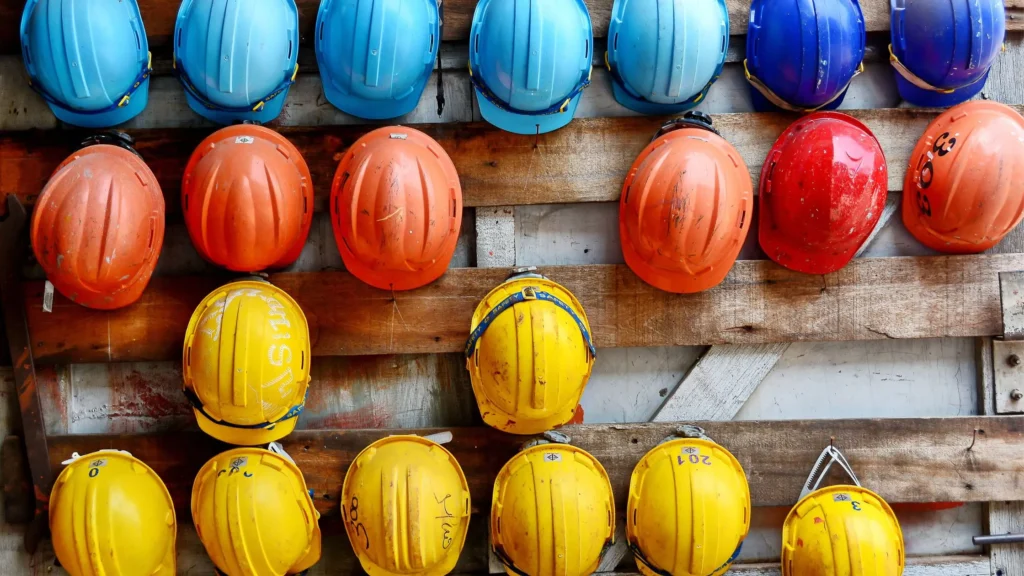
Colour coding is a practical site management tool that communicates a worker’s role at a glance — critical in a multilingual, multi-contractor UAE workforce. While there is no single mandatory national standard dictating exact colours, the following conventions are widely adopted across UAE major contractors, FIDIC projects, and Dubai Municipality-regulated sites:
| Helmet Colour | Role / Category |
| White | Site manager, project manager, engineer, client representative |
| Yellow | General labourer, plant operative |
| Orange | Slinger, signaller, banksman |
| Green | Safety officer, HSE representative, new starter / visitor on induction |
| Blue | Subcontractor, foreman |
| Red | Fire marshal, emergency response team member |
| Brown / Grey | Scaffolder (common convention on many Gulf projects) |
Implementing a visible colour-coding policy reduces response times during emergencies, simplifies site access control, and is increasingly required by tier-one contractors and project owners across the UAE and wider GCC.
Best Safety Helmet Brands Available in UAE (2026)
The UAE market is well-served by international PPE brands through authorised distributors in Dubai, Abu Dhabi, and Sharjah. The following brands represent the most widely specified and consistently available options across UAE construction and industrial procurement:
3M — H-700 Series and H-800 Series
3M’s helmet range is a staple on UAE mega-projects. The H-700 series offers lightweight HDPE construction with 6-point ratchet suspension and integrated ventilation, available in Class E rating. The H-800 Series introduces a Type II certified design with premium suspension for high-risk applications. Price range: AED 80–180.
Honeywell — Fibre-Metal and North Series
Honeywell’s range spans from economical HDPE options to premium polycarbonate and fiberglass designs. Widely specified on oil and gas projects in Abu Dhabi. The Fibre-Metal FH series is the industry benchmark for petrochemical and electrical applications in the UAE. Price range: AED 70–250.
MSA Safety — V-Gard Series
MSA’s V-Gard is one of the most recognisable helmets globally, and a common sight on UAE infrastructure projects. Available in full-brim and short-brim configurations, with both standard and high-heat variants. Excellent accessory ecosystem for face shields and ear protection. Price range: AED 60–160.
JSP — Evolution and Force Series
JSP is a strong value brand for large UAE workforce deployments. The Evolution series combines an ergonomic profile with a 6-point Touchfit suspension and EN 397 certification. Widely available from UAE distributors. Price range: AED 35–120.
Uvex — Pheos and i-vo Series
Uvex specialises in ergonomically designed helmets with excellent accessory integration. The Pheos series is particularly popular for supervisory and professional roles requiring long wear duration. Strong EN 397:2025 compliance documentation. Price range: AED 90–200.
How Long Does a Safety Helmet Last? Inspection and Replacement Guide
A safety helmet has a finite service life regardless of its visual condition. The polymer shell degrades through UV exposure, heat cycling, chemical contact, and the mechanical stresses of daily use — even when no single impact occurs. Most manufacturers specify a maximum service life of five years from the date of first use (or ten years from manufacture date — whichever is earlier). In UAE’s extreme UV and heat environment, a more conservative replacement at three to four years is advisable for outdoor helmets.
Mandatory Replacement Triggers
- Immediately after any impact — even if no damage is visible. Impact-absorbing materials deform permanently at a microscopic level during an event, compromising future protection.
- Any visible crack, dent, or deformation in the shell.
- Discolouration, chalking, or loss of surface gloss (indicates UV degradation of the polymer).
- Damaged, cracked, or frayed suspension webbing.
- Suspension that no longer holds adjustment correctly.
- Chemical contamination — if the helmet has been exposed to significant solvent, acid, or alkali contact.
How to Perform a Pre-Use Inspection
- Check the shell exterior for cracks, dents, or surface chalking. Flex the shell gently — a degraded shell will feel brittle.
- Inspect the inner suspension — check all six anchor points, the headband, the sweatband, and the ratchet mechanism for damage or stiffness.
- Verify the date-of-manufacture stamp moulded inside the shell. This is a clock symbol with a two-digit year and quarter indicator.
- Confirm the certification markings are legible — standard (EN 397 or ANSI), class (E, G), and manufacturer code.
- Check for any chemical contamination, deformation from heat, or paint/sticker application that may have penetrated the shell.
| Important: Never apply adhesive stickers, paint, or solvents to a safety helmet shell. These substances can penetrate the polymer and weaken its structural integrity — a risk that is invisible from outside but can cause catastrophic failure on impact. |
UAE Safety Helmet Buying Checklist
Use this checklist for every helmet procurement decision — whether purchasing 10 units or 10,000:
- ESMA certification mark present and verifiable on supplier’s documentation
- EN 397:2025 or ANSI Z89.1 compliance clearly stated on shell and datasheet
- Correct Type (I or II) for your site’s hazard profile
- Correct electrical Class (G, E, or C) for all roles on site
- Shell material confirmed as HDPE (outdoor) or PC/FRP (industrial/electrical)
- Suspension: 6-point ratchet for primary workers; 4-point minimum for all
- Vented design confirmed for outdoor workers (non-vented for welding/chemical roles)
- Accessory rail compatibility verified against required PPE accessories
- Weight under 400g for all-day wear roles
- Bulk purchase includes manufacturer’s certificate of conformity per batch
- Supplier is an authorised distributor — not a grey-market or unverified channel
- Replacement schedule documented (3–5 years from first use)
Frequently Asked Questions
Q: Is a safety helmet legally required on UAE construction sites?
A: Yes. UAE Federal Law No. 8 of 1980 (Article 91) mandates that employers provide appropriate PPE — including head protection — to all workers exposed to risk. Dubai Municipality and Abu Dhabi’s OSH framework enforce this on all regulated sites. Non-compliance carries financial penalties and potential site shutdowns.
Q: What does ESMA certification mean for safety helmets?
A: ESMA (Emirates Authority for Standardisation and Metrology) is the UAE government body that certifies PPE for compliance with UAE safety standards. Only helmets with a valid ESMA certification mark are legally compliant for commercial use on UAE-regulated worksites. Always request the certificate of conformity from your supplier.
Q: Is EN 397 accepted as the standard in UAE?
A: Yes. EN 397:2025 is the most widely cited standard on UAE project specifications. The 2025 revision is particularly important as it introduces a new Type 2 classification with a 98-joule off-crown impact test. ANSI Z89.1 is also accepted on projects governed by US contractor specifications.
Q: What is the difference between HDPE and ABS safety helmets?
A: HDPE (High-Density Polyethylene) has better UV resistance and higher-temperature stability, making it the preferred shell material for outdoor UAE construction sites. ABS degrades faster under prolonged UV exposure and is better suited to indoor industrial environments. In UAE’s climate, HDPE is the recommended default for outdoor workers.
Q: How long does a safety helmet last in UAE?
A: Most manufacturers specify a maximum service life of five years from first use. In UAE’s extreme UV and heat environment, three to four years is more conservative and advisable for outdoor helmets. Any helmet must also be replaced immediately after any impact event, even if no visible damage is apparent.
Q: What helmet colour does a safety officer wear on UAE sites?
A: By the most widely adopted UAE site convention, safety officers and HSE representatives wear green helmets. White helmets are worn by site managers and engineers. Yellow is for general labourers, orange for signallers and banksment, blue for subcontractors, and red for fire marshals.
Q: What class of helmet is needed for electrical work in Dubai?
A: Class E (Electrical) helmets, rated to withstand 20,000 volts AC, are required for electricians, MEP workers, and anyone working near high-voltage electrical infrastructure in the UAE. Class G (2,200V) is the minimum for general construction where incidental low-voltage exposure is possible.
Q: Can I use a motorcycle helmet or bicycle helmet on a construction site in UAE?
A: No. Motorcycle and bicycle helmets are not certified for industrial hazards. They are designed for different impact dynamics and do not meet EN 397, ANSI Z89.1, or ESMA industrial helmet standards. Using non-compliant head protection on a regulated UAE construction site is a direct legal violation.
Q: What is the best vented safety helmet for UAE summer heat?
A: For UAE summer construction, look for helmets with adjustable ventilation slots and a moisture-wicking inner liner — both features that significantly reduce heat build-up. 3M’s H-700 series, JSP Evolution, and Uvex Pheos all offer ventilated variants that maintain EN 397 compliance while improving thermal comfort in high-ambient-temperature environments.
Q: How do I spot a counterfeit safety helmet in the UAE market?
A: Red flags include: absence of a moulded certification mark inside the shell; inability to produce an ESMA certificate of conformity; unusually low pricing (below AED 20 per unit for ‘EN 397 certified’ helmets); missing manufacturer date-of-manufacture stamp; and suspiciously light weight with thin, flexible shell walls. Always purchase through an authorised distributor and request batch certification documents.
Conclusion: Getting Head Protection Right in UAE
Selecting a safety helmet for UAE construction or industrial work is not a purchasing decision — it is a compliance and risk management decision. The consequences of getting it wrong range from regulatory penalties to irreversible harm to the people your PPE programme is designed to protect.
The principles are clear: insist on ESMA certification, specify EN 397:2025 compliance (or ANSI Z89.1 where applicable), choose HDPE shell material for outdoor UAE roles, and deploy Class E electrical rating across your workforce as a default baseline. Implement a formal inspection regime and enforce a maximum four-year replacement cycle for helmets exposed to UAE’s outdoor conditions.
With the 2025 revision to EN 397 raising the bar for Type 2 helmets, 2026 is an important year to audit your current helmet stock and confirm alignment with the updated standard. Any procurement from ESMA-registered distributors should now reference EN 397:2025 — not the superseded EN 397:2012 — on their certificate of conformity.