Heat is the defining condition of workplace safety in the UAE. It is also the reason most PPE programmes here fail — not because the wrong equipment was bought, but because the right equipment became unwearable by 11am and came off.
This guide covers what the law requires during the summer months, how to recognise heat stress before it becomes an emergency, and how to specify PPE that workers will actually keep on in 45°C.
What is the UAE midday break rule?
The UAE operates a mandatory midday break for outdoor work during the peak summer months. Work in direct sunlight and in open-air areas is prohibited during the hottest part of the afternoon, across a defined period each summer, and the rule is enforced by the Ministry of Human Resources and Emiratisation (MOHRE) with inspections and penalties for non-compliance.
The rule has been in place for many years and the window is confirmed annually. Key points that apply consistently:
- It applies to outdoor work in direct sun — indoor and shaded work is treated differently
- Employers must provide shaded rest areas, drinking water and cooling facilities for the break period
- Certain essential and emergency works are exempted, subject to conditions and additional protective measures
- The break does not reduce total working hours — shifts are redistributed to cooler parts of the day
Confirm the exact dates and hours with MOHRE for the current year before building your site schedule around them. Our guide to UAE workplace safety regulations covers the wider legal framework, including Abu Dhabi’s OSHAD requirements, which layer additional obligations on top of the federal baseline.
Why the redistributed hours create a new problem
Shifting work to early morning and late afternoon solves the heat exposure problem and creates a visibility one. Both replacement windows are lower-light periods — pre-dawn starts and dusk finishes — often with plant and vehicles moving on site.
The practical consequence: retroreflective performance on hi-vis clothing becomes more important during the summer restriction period, not less. A faded Class 2 vest that was adequate at midday in March is a genuine risk at 5:30am in July.
Audit hi-vis condition before the summer schedule starts, not after.
How do you recognise heat stress?
Heat illness escalates. Catching it at the first stage is straightforward; catching it at the last is a medical emergency with a real fatality rate.
| Stage | Signs | Action |
|---|---|---|
| Heat rash | Red clusters of small blisters, usually where clothing traps sweat | Move to a cooler area, keep the area dry. Review PPE breathability. |
| Heat cramps | Muscle spasms, heavy sweating, thirst | Stop work, rest in shade, rehydrate with an electrolyte drink. Do not resume for several hours. |
| Heat exhaustion | Heavy sweating, cool clammy skin, weakness, dizziness, nausea, headache, rapid weak pulse | Stop work immediately. Move to shade or air conditioning, loosen or remove PPE, cool actively, rehydrate. Seek medical attention. |
| Heat stroke | Hot dry skin or profuse sweating, body temperature above 40°C, confusion, slurred speech, seizure, loss of consciousness | MEDICAL EMERGENCY — call 998. Move to shade, remove outer PPE, cool aggressively with water and airflow, do not give fluids to an unconscious person. |
The critical warning sign supervisors miss: a worker who stops sweating in extreme heat is not coping better — they are deteriorating. Absence of sweat during heavy exertion in high heat is a heat stroke indicator, not a sign of acclimatisation.
Confusion and irritability are also early indicators. A normally reliable worker becoming argumentative or making uncharacteristic errors in the afternoon is a physiological signal, not an attitude problem.
Who is most at risk?
- New arrivals. Acclimatisation takes one to two weeks of graded exposure. Workers arriving from cooler climates and going straight onto a full shift are the highest-risk group on any UAE site.
- Workers returning from leave. Acclimatisation is lost in about a week away. Someone returning from a month’s leave needs re-acclimatising, and rarely gets it.
- Anyone in impermeable PPE. Chemical suits, FR coveralls and full respiratory protection prevent evaporative cooling entirely.
- Workers with underlying conditions, or taking medication that affects hydration or thermoregulation.
- Anyone during Ramadan who is fasting — no fluid intake during daylight fundamentally changes the risk calculation, and work schedules should reflect it.
How should PPE change for UAE summer?
PPE that traps heat makes the wearer hotter than no PPE at all. The specification question is not “what protects most” but “what protects adequately while allowing the body to cool”.
Hi-vis and workwear
- Moisture-wicking polyester over heavy cotton drill
- Mesh ventilation panels at underarm and back
- Lightweight fabric weight within the required visibility class
- Long sleeves in lightweight fabric usually beat short sleeves plus sun exposure — UV is its own hazard
- Fluorescent yellow generally reads better than orange against UAE sand and concrete, unless the project specifies otherwise
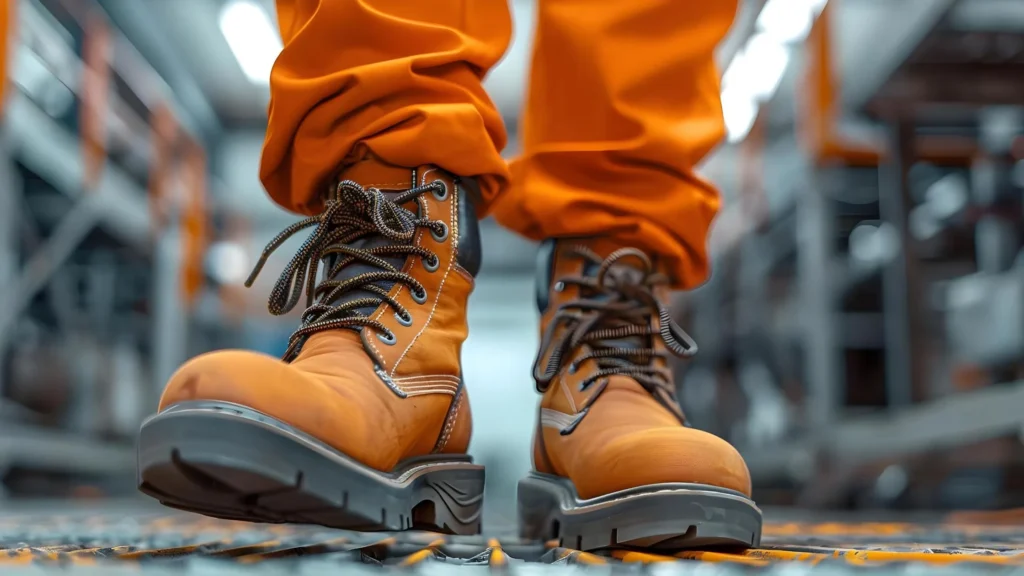
Safety footwear
- Breathable uppers — knit and mesh constructions rather than full leather where the task allows
- Moisture-wicking linings, and a second pair rotated so footwear dries fully between shifts
- Check the outsole heat rating: HRO marks resistance to contact heat, which matters on hot asphalt and steel decking
- Metal-free composite toecaps and midsoles conduct less heat than steel
Our safety footwear range includes knit and breathable constructions specified for hot-climate work.
Head protection
- Vented helmets wherever there is no electrical risk — the compliance improvement is significant
- Neck shades, which are inexpensive and prevent a meaningful amount of sun exposure
- Sweatband liners that can be replaced rather than degrading the harness
- Check the helmet’s temperature marking — shells sitting in direct UAE sun run well above ambient
See our safety helmet range for vented and non-vented options.
Hand protection
- Knitted backs with coated palms rather than fully coated gloves
- Order a size range — hands swell in heat
- Expect shorter service life; sweat degrades liners faster than temperate-climate guidance assumes
Respiratory protection
This is where heat and protection conflict most sharply. A negative-pressure respirator increases breathing effort, which increases metabolic heat production, in a worker who is already struggling to shed heat.
Where extended respiratory protection is needed in summer conditions, powered air-purifying respirators are worth the cost difference. They remove breathing resistance and deliver a continuous airflow that provides genuine cooling inside the hood or mask.
What else reduces heat risk?
PPE is the last line of defence. These measures come first:
- Water, accessible and cool. A drinking point 200 metres away during a break period does not get used. Bring water to the work face.
- Electrolytes, not just water. Heavy sweating loses salts as well as fluid, and water alone can worsen the imbalance.
- Shaded rest areas at the work location, not just at the site entrance.
- Graded acclimatisation for new arrivals and returners — build to full exposure over one to two weeks.
- Buddy system. Heat stroke impairs judgement, so the affected person is the least likely to recognise it. Someone else has to.
- Schedule the heaviest work into the coolest hours.
- Toolbox talks in the languages the crew actually speaks. A heat briefing delivered only in English on a multilingual site has not been delivered.
What are employers required to provide?
UAE occupational safety obligations require employers to protect workers from foreseeable workplace hazards, and heat is the most foreseeable hazard on a UAE outdoor site. In practice, meeting that obligation during summer means providing at minimum:
- Compliance with the midday break restriction
- Shaded, cooled rest facilities
- Cool drinking water and electrolyte replacement
- PPE appropriate to both the hazard and the thermal conditions
- Training on heat illness recognition and response
- First aid provision capable of responding to heat stroke
Abu Dhabi’s OSHAD framework and individual free zone authorities impose additional requirements. Main contractors frequently specify above the legal minimum. Our guide to PPE requirements for UAE construction sites covers the detail — and always confirm the current requirement with the relevant authority, since specifics are updated periodically.
Frequently asked questions
What is the midday break rule in the UAE?
Work in direct sunlight and open-air areas is prohibited during the hottest part of the afternoon across a defined summer period each year, under rules enforced by MOHRE. Employers must provide shaded rest areas and drinking water during the break. Confirm the exact dates and hours with MOHRE for the current year, as they are announced annually.
Does the midday break apply to indoor work?
The restriction targets outdoor work in direct sunlight. Indoor and shaded work is treated differently, though employers remain responsible for managing heat exposure in any environment where it presents a risk — including unventilated indoor spaces, which can exceed outdoor temperatures.
What is the first sign of heat stress?
Usually heavy sweating with weakness, dizziness, headache or nausea. A critical warning sign is a worker who stops sweating during heavy exertion in extreme heat — that indicates heat stroke, not improvement, and requires immediate emergency response.
Can workers wear less PPE because of the heat?
No. The hazard the PPE protects against does not go away in summer. The correct response is to specify PPE that provides the required protection with better breathability — vented helmets, moisture-wicking hi-vis, breathable footwear — and to adjust work scheduling, hydration and rest, rather than reducing protection.
How long does it take to acclimatise to UAE summer heat?
Typically one to two weeks of graded exposure. Acclimatisation is lost after approximately a week away from the heat, so workers returning from leave need re-acclimatising. New arrivals in their first fortnight are the highest-risk group on any UAE site.
What should you do if a worker collapses in the heat?
Treat it as heat stroke until proven otherwise. Call 998. Move the person to shade or air conditioning, remove outer PPE, cool aggressively with water and airflow, and do not give fluids to anyone who is unconscious or confused. Heat stroke has a significant fatality rate and outcomes depend heavily on how fast cooling begins.
Does hi-vis clothing get hotter in the sun?
Fluorescent fabrics do absorb heat, but the greater factor is fabric construction and weight. A lightweight, moisture-wicking, mesh-ventilated hi-vis garment is considerably cooler than a heavy cotton one of the same colour. Specify on construction, not just on visibility class.
Specifying summer PPE for your site
Safe Gear supplies PPE specified for UAE conditions — breathable hi-vis, vented head protection and knit-construction safety footwear built for heat rather than adapted for it. If you are reviewing your summer specification, send us your current PPE list and we will tell you where the heat-related weak points are.
Related reading: the most common PPE mistakes workers make, UAE workplace safety regulations explained, and our PPE lifespan guide for realistic replacement intervals in this climate.